2026
In this essay, Jon Ippolito discusses the meaning of "friction" in the context of higher education, via an exploration of what friction entails, what varieties are beneficial for students, and what aren't. In doing so, he creates the starting point for conversation in "Friction and Education: The Discussion".
In this conversation, provoked by Jon Ippolito's essay "Does Education Really Require the F-Word?", researcher-educators Jon Ippolito, Annette Vee, Maha Bali, Jeremy Douglass, Mark C. Marino, and Marc Watkins discuss the role of friction in higher education after the dawn of generative AI.
Using Jon Ippolito's essay "Writing As Thinking—By Proxy" as a vehicle for discussion, researcher-educators Anna Mills, Mark C. Marino, Maha Bali, Jeremy Douglass, Annette Vee, Marc Watkins and Ippolito discuss the impact of AI's emergence in higher education and the many strategies they're employing to foster healthy writing practice with and without AI.
In this provocation, Jon Ippolito questions what human capabilities AI extends and what capabilities it removes. In doing so, he charts the evolution of human writing processes alongside technology while speculating on what future human writing practices will look like.
Daniel Johannes Rosnes' playful review of Kyle Booten's Gyms sees Rosnes at the mercy of an AI writing companion, who aides his reflection on the exercises Booten provides and the ways in which they reveal the potentialities and pitfalls of large language models.
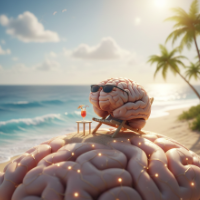
In this insightful interview, Rob Wittig, Mark Marino, and ChatGPT—prompted into the far wittier persona of Chatty G—discuss LLM assisted writing processes, the dangers of extreme empathy post-AI, and the influence of netprov on Hallucinate This! An Authoritized Autobotography of ChatGPT.
Stuart Moulthrop's meditation on AI artistic production explores the pareidolia at play in human interactions with generative models while arguing, via Wim Wenders' Until the End of the World (1991) and Greta Gerwig's Barbie (2023), for a loving approach to humanity's newest tools.
2025
Eman Younis and Hisham Jubran's study investigates Arab university students' exposure to digital literature and their attitudes toward it. In doing so, they discover students feel the inclusion of digital literature in university-level literature courses should be a scientific necessity and that its absence in the curriculum compromises their professional development.
Will Luers contributes to current debates on AI by engaging with Jeffrey West Kirkwood's Endless Intervals: Cinema, Psychology, and Semiotics. Luers examines the parallels between AI and cinema technology as "thinking machines," both structured around intervals that produce perceptual and conceptual unities. What we have, in cinema and AI no less than human cognition, "is a reevaluation of the unity of consciousness."
Tuuli Hongisto explores the problems of cyborg authorship through the presentation of ChatGPT as a co-author of literary works on Amazon. Rather than shying away from admitting that an AI took part in the writing process, these authors position ChatGPT and other LLM's as authors with their own rights, rather than tools.

2024
Marino and Berry discuss their engagement in weekly conversations about the nature of "code, of ELIZA, its descendants" and how each of these programs have circulated within our critical code culture, along with other "contemporary conversation agents like Siri and ALEXA and, of course, ChatGPT."
Off center, wayward, slightly off path.... Rettberg and Luers discuss their longrunning encounters with writers, artists, computational film makers and other multidisciplinary "people who come to the electronic literature community, and it’s not only writers, but also artists, visual artists, and you find everyone has a similar kind of wayward path."
Like so many generic literary reconstructions, comics are now being transformed into information -- a process that, for postdoctoral scholar Ilan Manouach, is concomitant with the expansion of tools and services in the field of generative AI. Like so many AI emergences (and emergencies), this one poses important challenges to the comics industry and the careers of comics professionals.
Can ChatGPT or other Chatbot interfaces really write anything better than a feeble imitation of postmodern cut-up techniques? Polina and James Mackay think so, and they offer some reasons for holding onto a human, guiding intelligence in the writing process.
With this brief look at Large Language Model surrealism, Nick Montfort locates and identifies "the id of the internet, of publishing, of podcasting."

Scott Rettberg, director of the Center for Digital Narrative (CDN), in conversation with Nick Monfort, who is leading the CDN's Computational Narrative System's research node.

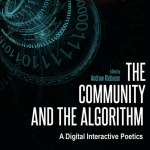
Daniel Punday reviews Andrew Klobucar’s edited collection of essays, The Community and the Algorithm: A Digital Interactive Poetics.
2023
Multimodal AI trained on YouTube-TikTok-Netflix (object-segmented and identified audio-video-speech) and public domain science data (that exceeds the spectrum of human sensorial field) will be grounded in a world that is in some ways vaster than that experienced by a single human neurophysiology.
Accepting Søren Bro Pold's proclamation that "the social knowledge base of the University has already disappeared", Davin Heckman locates a few, forward looking prospects for a reconstruction of the Humanities in Jean-François Lyotard's "famously sloppy" Postmodern Condition (1971), Hannah Arendt's Human Condition(1958), and Imanuel Kant's prescient hope that the University could serve as a "mediating nexus among a growing array of conflicting professional tendencies."