A Posthumanist Genealogy 'Of Being Numerous' in Steve Tomasula's Ascension: A Novel

Providing insight into posthuman narrative strategies, Laura Shackleford analyses Steve Tomasula's novel Ascension (2022) for relational points of interest. Who or what is ascending who or what, and to what end?
imagination morte imaginez (imagination dead imagine) the title of Samuel Beckett’s 1965 experimental prose narrative with its impossible demand on human readers to imagine the end of imagination, resonates in new ways in the 21st century. Today we confront the planetary, material, and conceptual limits of global systems driven by state-sanctioned authoritarianism and imperialism, dynastic late-capitalist Robber-Barons, increasingly agential AI, and reckon with the Anthropocene as a geological force and attendant polycrises of ecological collapse. Citing Beckett’s title in a 1996 essay speculating on the novel’s ability to adapt to socio-technical and historical changes, Steve Tomasula writes: “Imagination dead, Imagine,” his intruding comma shifting emphasis onto the imperative to imagine, even if only to imagine the end, i.e., to confront the limits of our human perception, preoccupations, technological striving, and entangled collective behavior within radically transforming ecosystems whose agency and complexity we only begin to apprehend (“Three Axioms” 100).
Focusing on Ascension: A Novel as a critical posthumanist genealogy of present-day, 21st century algorithmic ecosystems, I will suggest how the novel revisits the “convergences among natural and constructed ecosystems, green politics and grey matter, silicon chips and sand” explored in ebr4’s “Critical Ecologies” thread, “Green and Gray,” first co-edited by Joseph Tabbi and Cary Wolfe in 1996.1 This thread registers the complication of “natural” and “human-built ecosystems,” as “the relations of humans to both natural ecologies and technological symbol-systems” became “something more or other than metaphorical.”
Ascension, notably, approaches present-day environments, now inextricably green and gray in their capacity as algorithmic ecosystems.2 This approach usefully counters predominant conceptions of AI as a standalone technology (and fetish-object) by situating these sociotechnological developments in relation to broader ecosystemic, political, and economic changes. As algorithmic ecosystems, the planetary scope of these sociotechnological networks is clearly inseparable from anthropogenic climate change and the environmental crises we face. Ascension recognizes the myopic capitalist and imperialist logics relentlessly driving these systems and the Earth system towards catastrophic tipping points. Aligning today’s algorithmically-driven systems with three prior, disjunctive moments in modernity and locating all of these within a broader frame yet - of Earth systems science, evolutionary biology and geological time — the novel complexifies the very concept of ascension and the linear, progressive narratives of human-driven, sociotechnological triumph this concept reinforces. Ascension reopens the question: Who or what, exactly, is ascending who or what, and to what end(s)?, a primary throughline in the novel and our present-day lives.
As we’d expect from Tomasula, Ascension enlists the novel as a literary form and some of its most (and least) common narrative, textual, visual, and spatiotemporal strategies to address these latest sociotechnical and ecosystemic transformations. It confronts the narrative and imaginative limits we face as the Earth system can no longer be taken for granted as a semi-stable backdrop to human activities. The modern novel and dominant time scales of narrative and the teleology of (human-driven) plots set against a passive natural setting, what Monika Fludernik describes as narrative’s “anthropomorphic bias,” has reinforced human-centric perspectives that exacerbate today’s anthropogenically-catalyzed ecological crises (13). Donna Haraway has, therefore, called on “story telling for earthly survival,” story telling that is capable of engaging with the present complexity of ecologically and technologically entangled, “more-than-human” life at a planetary scale.3
Ascension identifies the potential and necessity for narrative to help respond to these instabilities now that planetary survival is a constant material threat. My reading of the novel extends econarrratologist Erin James’ view that the “categories and concepts of current narratological models are insufficient for our epoch” because “narrative is changing along with the world in which we tell and receive stories” (14). In this context, I’ll argue Ascension provides insight, using novelistic and narrative strategies to counter the “anthropocentric bias,” by addressing shifting human knowledges of bio-evolutionary and geological change on Earth that have grappled with, and, necessarily, fallen short in apprehending more-than-human Earth systems of which they are a minor, destructive part. Ascension prompts encounters between what Dipesh Chakrabarty has differentiated as “geological time” and “world historical time” and their respective “planet-centered” and “human-centered” ways of thinking (Anthropocene Time 23). Whereas the concept of the Anthropocene often conflates these two times and “modes of being human,” Chakrabarty differentiates these temporal scales, identifying the problem they pose because geological time unfolds at a scale and pace utterly at odds with the temporality of human history and, therefore, the former eludes our affective and political engagement. Even as humans have become a geological force in complex interplay with a larger Earth system, the species cannot control, or coordinate interventions at the geo-bio-evolutionary scale at which multispecies assemblages, geological, and technological forces unfold.
I will suggest that Ascension’s narrative and novelistic engagements with history at multiple, decidedly more-than-human scales differentially folds the planet’s geological time back into the world-historical time of humans, inhabiting this disjuncture and suggesting how these vastly discrete scales and experiences of time might inform everyday experiences of life and collective action, while remaining outside any species’ or system’s control. The novel’s strategies to re-cognize the present-day and an Earth system in crisis elaborate a valuable strain of “ecological posthumanism” in Hannes Bergthaller and Eva Horn’s understanding of this as the awareness that the separation of natural and human domains, the green and the gray, “was always a dangerous delusion, a denial of humans’ primordial connectedness to the Earth which the Anthropocene is now again rendering inescapable, and even an ideological ruse justifying the dispossession and subjugation of the Earth’s peoples, human and otherwise” (Bergthaller 38). Ascension illustrates, equally, how critical posthumanist perspectives on multispecies, ecosystemic and evolutionary change can feed into a discourse of the “technosphere” that unites green and grey as inevitable, evolutionary and geological forces predestined to surpass the human species and, displace human historical time and collective agency altogether.
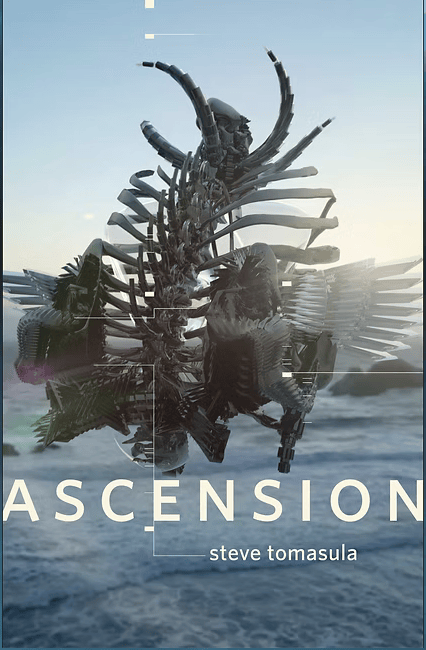
The novel’s title, Ascension, and its cover, which features an otherworldly sky-blue landscape and centers on an impossibly large dinosaur/bird skeleton with mechanical legs and wings no longer able to take flight, initially invoke ascension as a process of human transcendence over material limits through technologically facilitated, spiritually predestined means. Ascension in this sense is a “tending upwards,” or “a rise from inferior to superior” (OED 482). Subtle lines breaking the cover’s image into smaller frames signal techniques of machine vision, connecting the novel’s title to the latest machine-learning AI advancements, which are often envisioned as the latest means of ascension, a “transcendence machine promising immortality” in philosopher Mark Coeckelbergh’s description of the transhumanist extreme of this view, which informs Muskian, Bosozian, and Thielian visions of the algorithmic future in slightly more subtle ways (25). This concept of human ascension is a recalcitrant continuation of Euro-American, patriarchal capitalist imaginaries of modernity and settler colonialism and imperialism, an understanding of the “anthropic: the one who looks up, the one who is not of the earth, the one whose feet are in the mud but his eyes are in the sky,” bent on transcending mortality, abstracting and dematerializing human knowledge at the expense of everything else, even planet Earth, hardly a novel desire, at all, and one that has “done us dirt in Western cultures,” according to Donna Haraway.
This anthropocentric understanding of ascension is invoked only to be undercut in the novel’s opening pages by the narrative’s shift to a cosmic scene and scale. A two-page spread comprised of text against an all-black image of star-speckled outer-space provides a temporally condensed, yet spatiotemporally sprawling narrative of the origins of our universe and “millenniums of eating, suffering, breathing, birthing, living, mating, dying, decaying, composting, sprouting—all life — playing out, becoming this thin earthen skin” (Tomasula, Ascension 8). Opening up this planetary, geological scale of “deep time,” 4 the novel displaces readers’ predominant human conceit of transcending material limits through sociotechnological means and opens up a consideration of ascension at the scale of the Earth system’s multispecies, material, evolutionary and planetary processes, which have no clear, single, knowable subject, object, or teleological ends.5
These opening pages introduce a sense of spatiotemporal disjuncture that is primary to the novel’s dynamic, multiscalar narrative strategies. As narratologist Marco Caracciolo describes similar “cosmic summaries” in fiction, this passage “introduces an astronomical scale that causes a sudden, significant distanciation from any recognizable human temporality” (185). The “narrated events involve temporal units much larger than the typical timespan of narrative (and of human life and society)” (185). Paradoxically, the “fast pace of cosmic summary’, condensing the evolution and existence of a universe into a single paragraph, results in “temporal compression” and a contemplative slowness for readers “whereby more-than-human events are packaged in a way that makes them accessible to the human imagination” (186). For a filmic analogue, think of 2001: A Space Odyssey and its compression of human evolution to a scene in which an alpha ape thrusts his bone-tool-weapon into the air, and viewers follow the bone through the atmosphere across millennia, in slow motion to a future space station in vast outer-space led by the AI, HAL.6 Caracciolo sees ecological value in such narrative methods, which induce a detached, contemplative state in readers that “defamiliarizes their everyday experience of human control and mastery” (187). This is just one of the novel’s strategies to encourage readers to momentarily “leave the temporal scale of ordinary human experience,” “distance themselves from anthropocentrism and human exceptionalism,” and attend to “human-nonhuman interconnections,” whether these are vast Earth systems seen from the cosmos, or comparatively miniscule, “multispecies assemblages” of humans, birds, ectoparasites, and microbiological viruses” (187).
This disjuncture between the deep time of the Earth system and historical experiences of time and space, is accentuated further by our unnamed narrator’s insistence that “IT / didn’t / have to happen / this way (or at all) the way we say,” underscoring the incommensurability of more-than-human cosmic evolutionary and geological processes with human language, narrative, and scientific understanding. This perspective from nowhere parallels Earth system science’s understanding of the planet, itself, as a plural “it,” “an unstable system made up of imperfectly interlocking processes (including the human as a planetary force)” (Chakrabarty, “Anthro Time” 28). The narrator flags the radical contingency of their narrative, and human knowledge of the cosmos, marking language and narrative as technics. Technics, establish an irreducible, constitutive distinction between humans and their exterior milieu. They entail “the pursuit of life by means other than life,” in Bernard Stiegler’s phrasing, whereby the anthropos is sustained by means outside ourselves and outside life, whether the medial exteriorization that constitutes humans’ interiority involves natural language, daguerreotypes, drawings, DNA, data mining, carbon-based AI, etc. (17).
After this initial cosmic scene, the narrative unfolds across three chapters, all set in the Paraguayan capital of “Asunción,” adding additional semantic layers to the novel’s engagement with processes, and now places, of ascension. Far from transcending material, terrestrial life on earth, this physical setting largely counters the semantic association of ascension with human transcendence of material limits by foregrounding how thoroughly the novel’s characters and their aspirations are enmeshed with this physical location and broader, more-than-human material and geological processes, geopolitical networks, and living histories unfolding here. Although the city’s name commemorates the Catholic belief in the Virgin Mary ascending to heaven, this 16th century naming of the city was key to Spanish colonizers’ evangelization of the indigenous Guaraní people, which operationalized earthly transcendence as a form of spiritual, cultural, linguistic, economic indoctrination on Earth.
Bringing the narrative back down to earth and the human scale of individual characters, each chapter focuses on a distinct paradigm shift in modernity’s scientific, aesthetic, and epistemological practices, leading to the final chapter’s setting in a cataclysmic near-future after the polar ice caps have melted. Chapter I unfolds in Asunçion, Paraguay in 1859, post-independence from Spain; Chapter II jumps forward in time to this exact site in Asunçion as the bioinformatic sciences begin to reign in 1980; and Chapter III returns to Asunçion in 2025+, with Gabe, a young, punk microbiologist carrying out research on bird lice with tangential, but meaningful ties to the prior scientists’ work.
Each chapter’s primary characters are scientists and assistants seeking to understand evolutionary processes by reading the traces of dying or lost worlds, while they simultaneously grapple with the limits of their own, soon to be residual, if not obsolete, sociotechnical and onto-epistemological paradigms. Colorful maps, images, drawings, scientific diagrams, a documentary screenplay, genetic models, etc. thicken Ascension’s critical posthumanist attention to the processes through which understandings of more-than-human life, planetary processes, and their interrelations gain legibility and, eventually, succumb to new sociotechnical methods and understandings of life on Earth.
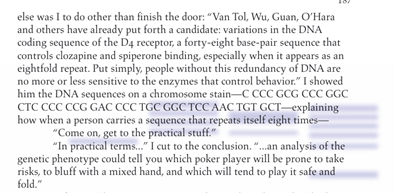
In this way, Ascension catalogs diverse ways of telling the story of planetary life and the distinct spatiotemporal worlds of meaning they open onto, celebrating the valuable plurality of this media archaeology as onto-epistemological technics continually reshaping humans’ relations to more-than-human ecosystems and the Earth system in limiting and expansive ways, at once.
The novel’s macro structure parallels the scientists’ interest in lost or dying worlds, and the sociotechnical, cultural, material, and geological processes that so radically and abruptly transform them. Telling the story of three scientists and their teams as they search back in time to unearth the evolutionary history of birds, bird lice, and human immunity to viruses spread by birds, the novel bridges three eras, staging a genealogical approach to understanding our near future and its limits by “ascending,” in a third sense, which entails “going back in the order of genealogical succession; reversion to an ancestor, or tracing lineage upwards, i.e., back in time” (OED 483). This recursive retracing and redoubling of what is presumed to be progressive, unidirectional evolutionary time is humorously reinforced by the use of bidirectional arrows as section breaks in Chapter I. Ultimately, Ascension’s first two chapters “ascend” back in time to prior moments in modernity to offer a scientific, cultural, and aesthetic genealogy, in Foucault ‘s sense, that reveals the historical contingency and discontinuities of discursive formations leading to the near-future 21st century, algorithmic ecosystems at the center of Chapter III, and unearths alternative paths that could and might still unfold otherwise.
Chapter I: Transformation, narrated in the third-person, focuses on an American professor of natural history, circa 1859, who laments the “volcanic” advent of Darwinian science, photography, and laboratory observation, which are displacing practices of natural history and their claims to a divine, unchanging, unified Truth, the “majesty of Nature one with the Divine” (Tomasula, Ascension 13). Searching for the fossils of the gigantic dinosaur-like Guyra Kyhje, or “Terror Bird” in the forests of Paraguay “to prove that species were continuous,” the Professor can no longer deny the “End of his world” (27, 13). Excerpts from the Professor’s journal, colorful drawings of insects engravings, and geological stratigraphy maps provide spatiotemporally distinct material traces indexing the centrality of these residual sociotechnical, aesthetic and material practices to the Professor’s era and understanding of the world, even as they succumb to modernity’s secular faith in Darwinian evolution, and empirical data (on the eve of digital computation via morse code and telegraph systems). The Professor rails against these changes: “It. What animal or plant, for that matter, can ever gain a fair trial when this is the language of its court?” (55). He imagines a vast “economy of nature” of which humans are a small part, challenging the idea of man’s “dominion over all the earth” (55). Reflecting on fossils, which are “nature’s memory,” and his guide, Raul, and the indigenous Aché beliefs, as well, he suggests that these “remind us that there are many worlds, not just ours” (55).
Invoking the problematics of human language, as did our initial narrator, the Professor’s journal speculates: “So this is a story about Nature but it won’t seem that way since I am writing it. And you are reading it. And whatever I write won’t be ‘it’ and whatever you understand won’t be what I meant: All Life is here, but it has nothing to do with us” (17). His reflections and the reference to ‘it’ build on the opening summary of the Earth system and the narrator’s awareness of the gulf separating human language and narrative, as technics, from the vast material processes involved in the planet’s emergence. We are reminded that “Nature” is not “it” the Professor differentiating his description of the Paraguayan forest in the language of his faith-based natural history “as a place where the air is ruled by the birds, the earth the worm, and no army can overthrow the flea” from that of Raul, his Paraguayan mestizo guide (also a primary focalizer in this chapter) who has an animistic understanding of the forests as far more than a physical object or thing (13).
This recurring railing against “it,” we come to fully realize much later in the novel, expands thematically and poetically on George Oppen’s 1968 serial poem, “Of Being Numerous.” The first poem in the series, its first stanza directly quoted on the opening page of Chapter III, observes:
“There are things We live among ‘and to see them Is to know ourselves’.
Occurrence, a part Of an infinite series,
The sad marvels; Of this was told
A tale of our wickedness. It is not our wickedness.
‘You remember that old town we went to, and we sat in the ruined window, and we tried to imagine that we belonged to those times - It is dead and it is not dead, and you cannot imagine either its life or its death; the earth speaks and the salamander speaks, the Spring comes and only obscures it — ’ ”
The poem’s invocation of unnamed, or unknowable “things / We live among” foregrounds the collective dimensions of our existence and the mutually constitutive character of these relations. “Occurrence” as a material-historical process and “infinite series” takes on a collective, planetary scale, reminiscent of the “milleniums” of births and deaths and suffering occurring across planetary time cataloged by our narrator in *Ascension’*s opening pages. Apprehending the “sad” tale of humans’ minor part on this vast scale of geological time, the poem refuses to explain “human finitude” by way of original sin (Nicholls 31). The next lines, a quote of Mary (Oppen’s partner), again confront the limits to human imagination as “we tried to imagine that we belonged to those times - It is dead and it is not dead, and you cannot imagine either its life or its death; the earth speaks and the salamander speaks, the Spring comes and only obscures it-”
A poetic analogue to the Professor’s fossil-hunt and attempt to bring a past moment in evolutionary time into human language, the lines — “It is dead and it is not dead, and you cannot imagine either its life or its death” — speak to the liminal status of our intersubjective experience of the world, through pronouns such as “it,” which persist, as language, and blur the line between living and dead. Imagining the earth and the salamander speaking, amidst Spring’s transformations, the poem connects historical time to the evolutionary, planetary time of more-than-human life, underscoring humans’ inability to imagine these forces even as they are key to “…know[ing] ourselves.” “It,” in Mary’s lines, seems to register both the pronoun “it,” “which is dead,” and the “existence of things,” or the material world and geological time the pronoun indexes, which is “not dead,” and, instead, as matter, encompasses “an unmanageable pantheon.”
The second poem continues with the salamander and the Earth speaking at this multispecies, planetary scale:
“So spoke of the existence of things, An unmanageable pantheon
Absolute, but they say Arid.
A city of the corporations
Glassed In dreams
And images—
And the pure joy Of the mineral fact
Tho it is impenetrable
As the world, if it is matter, Is impenetrable.”
This continues the encounter with the experiential limits of language and poetry as they confront the Earth’s ongoing, “impenetrable” processes of living, which include the second nature of “corporations” and their cities “Glassed / In Dreams.” In a letter, Oppen insists that “the existence of matter cannot be explained. We do not explain it, but find it. ‘and by this we are carried into the incalculable,’ (Selected Letters 16, 16, 13, Qtd. In Nicholls). “It” is explicitly aligned here with the “impenetrable” material world, with the numerousness of Earth’s “incalculable” being in time. “Of Being Numerous” inhabits the disjuncture between the individual, experiential time of the poet contemplating a vanishing world and the planetary spacetime at which the “incalculable” character of matter and “the mineral fact” unfold. Poem 7 returns to acknowledge human finitude, the bewildering “…shipwreck / Of the Singular” and, nonetheless, turns collectively toward “the meaning / Of being numerous.”
“Obsessed, bewildered
By the shipwreck Of the singular
We have chosen the meaning Of being numerous.”
Staging this multiscalar leap from the poet’s singular, human encounter to the multispecies, material, and geological processes informing more-than-human life and the Earth system across evolutionary time, “Of Being Numerous” resonates with Ascension’s expanding and contracting narrative acrobatics, which oscillate between planetary spacetime and the historical scale of characters’ individual experience amidst multispecies assemblages of more-than-human life, however tiny, by comparison, and then back again to the dynamic scale of evolutionary, planetary time. The novel’s narrative techniques encourage readers to inhabit the disjuncture between our sense of time and the planetary spacetimes that increasingly intrude upon the former, illustrating the necessity of such efforts, past and present. These multiscalar dynamics contribute to the project Chakrabarty identifies, which is to:
“connect deep and recorded histories and put geological time and the biological time of evolution in conversation with the time of human history and experience,” including “telling the story of human empires — of colonial, racial, and gendered oppression,” “in tandem with the larger story of how a particular biological species, Homo Sapiens, its technosphere, and the species that co-evolved with, or were dependent on homo sapiens came to dominate…without ever taking our eyes off of the hollowed human who continues to negotiate his or her own phenomenological and everyday experience of life, death, and the world.” (Climate of History 7-8)
Ascension portrays each of its primary characters’ attempts to ascend their historical moment and time and grapple with the meaning of “it,” however circumspect and incomplete, through these redoubled movements of expansion and contraction, conceptually and poetically iterating on the conceit “Of Being Numerous.” For the Professor, being “numerous,” or “more than one” (OED 261) involves an embrace of all God’s creatures and a recognition that “there are many worlds, not just ours” (Tomasula, Ascension 55). The Professor’s aspirations to “Being Numerous,” his openness to other worlds and material processes of multispecies evolution at a planetary scale do not release him from the “Shipwreck of the singular;” he is bitten by a tiny insect, likely a bird louse or other ectoparasite, and succumbs to a fever-laden illness. His singular life is swept up by collective forces of social, evolutionary, and planetary history, not without irony as he thoroughly minimized the threat posed by this tiny creature even as he celebrated the natural world in other ways.
Whereas the Professor mourns the incommensurability of human language, nature, and, god, in Chapter II “A Little Truth,” Jane Korzeniowski comes to terms with the necessary evil of scientific metrics, which make knowledges of the world and ourselves possible, while she resists the emergent bioinformatic sciences: “Dipteria, Pscoptera…How expansive her drawings of insects seemed compared to the strings of genetic letters that biology was starting to turn every animal into”(91). Jane is searching for a prehistoric louse that appears to have been specialized to live on an animal that had both reptile skin and feathers, the infamous feathered bird-dinosaur, Archaeopteryx, which will help her establish an evolutionary link between dinosaurs and birds and challenge what she believes to be a reductively linear and hierarchical evolutionary story. “I just want a little truth!, Jane exclaims to Arthur, the filmmaker who is documenting her search for the world’s most consequential bird lice (105).
While Jane mourns the advent of DNA and bioinformatic sciences and their displacement of her narrative, observational approach to evolutionary biology, Arthur holds on tight to his dream of a filmic masterpiece featuring a single, painstakingly slow shot of him capturing a dying puddle in the sunlight, protecting it with his own shadow as long as possible. He sees his filmic art “going extinct” as a result of the explosion of digital video and camcorders and the consumerist, capitalist orientations of his employers. Textual narration, structured like a shooting script, is interspersed with video stills of these same events, foregrounding the onto-epistemic impact of Hollywood movies, hand-held video, and DNA on the characters’ sense of themselves and their world.
In this chapter, slime mold, an evolutionary material and collective process that underlies higher forms of collectivity and autopoiesis, informs Jane’s understanding “of being numerous,” in her late 1980’s sense of the collective, microbiological forces driving life on Earth and her recognition of multispecies assemblages, such as the humans, lice, birds, and viruses she studies, as an invaluable, fascinating norm of planetary life. Jane describes a previous roommate who threw out her aquarium of slime mold, being “unable or unwilling to comprehend how its stench held the beauty of the Earth generating a bubble-thin atmosphere that made flowers and blue skies and stench — and roommates and their arguments — possible, too…” (137). Jane’s story underscores the complex and ongoing interdependence of these most primary, unicellular evolutionary processes, their centrality to multispecies assemblages supporting human life, and to the Earth system writ large. A self-organizing system, slime mold is a type of unicellular organism that, when needed, has the capacity to temporarily join together to form a collective, multi-cellular organism. This familiar example of collective, autopoietic organization invokes humans’ evolution through “symbiogenesis” as biologist Lynn Margulis describes the processes through which humans and other multi-cellular organisms emerged out of precisely such co-ordinations between unicellular life forms (32).
Extending Jane’s multispecies view of collectivity and numerousness from the biological up through differentially social and symbolic realms, in the final pages of the novel, the narrator thanks slime mold and similar, self-organizing systems, as the basis and “origins of Social Evolution,” describing how “slime mold Dictyostelium discoideum lives as thousands of independent cells. But when food becomes scarce — that is, when the individuals have to pull together to survive — these thousands of cells independently seek out each other, becoming, without any queen or even a brain, a single animal that can creep along the jungle floor, eating, growing hardier, making itself more able to survive” (Tomasula, Ascension 379). Jane and the novel, thus, draws this connection between material processes of symbiotic co-evolution and higher orders of human sociality that rely, equally, on evolving, technically entangled, multispecies assemblages, adding additional layers and an appreciation of human commensals, like lice and fleas, to our understanding of “being numerous.” Jane’s search for this prehistoric bird louse reaches its dead end when the rain forest location she last sighted it is razed, though she stumbles across the Professor’s sextant there, and does succeed in publishing her theory that the indigenous Aché likely developed an immunity to bird lice-borne viruses due to their frequent exposure to the dead parrots often worn around their necks.
Chapter III Ascension brings to the fore the primary characters’ slow realization that as much as their methods of inquiry bring unseen or lost worlds to light, they are, themselves, undergoing change, as a result of much larger, systemic evo-tech-cognitive processes.
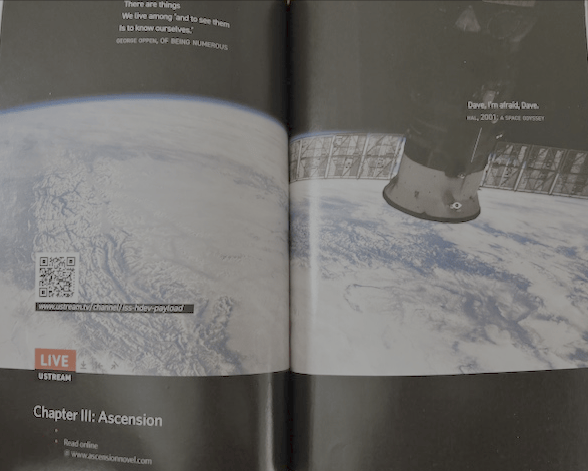
This chapter returns to a cosmic scale with an extraterrestrial image of planet Earth, taken by a satellite. It features a direct quote of the opening lines “Of Being Numerous,” juxtaposed to a quote from HAL, in 2001: A Space Odyssey (also released in 1968): “Dave, I’m afraid, Dave” (Tomasula, Ascension 163). Numerousness, here, and the invocation of HAL’s fear, is unequivocally tied to computation and the algorithmic systems co-orchestrating the World Wide Web and informatic infrastructures today. There is a QR code linking readers to “LIVE” “ustreamtv,” and a Web link to read the chapter entirely online @www.ascensionnovel.com, adding another semantic layer to the concept of ascension, as a reference to our digital networks, GPS satellites, social media, and this chapter’s actual presence on the Web. The next pages feature our unnamed narrator describing “the end” of our current planetary system as the Polar shelves collapse leading to massive rises in the sea level, flooding, and mass migrations of the “bottom billions,” “while those nations that remained dry installed fences and cameras and guards and tightened the mesh of their electronic screens as if that would help” (166). The chapter then shifts to the human scale and perspective of Gabe, a young woman tending a collection of lice, sand flies, and Blue Fronted Parrots, ducks, geese, and other birds in glass containers in the insectarium she manages in Paraguay. The bioinformatic turn of the 1980’s has expanded to the level of population genetics and gene editing and Gabe’s employer, Olympia, with a god-complex fitting her name, is the PI of a U.S. Defense-funded research project that takes Jane’s hypothesis that indigenous Aché’s peoples’ frequent exposure to parrots, and thus to bird lice, has given them immunity to viruses frequently spread through ectoparasites such as fleas and bird lice. Olympia and her international research team members, alternately serving as focalizers, are researching ways to genetically modify lice to allow them to immunize birds, or potentially humans, against avian flu.
Olympia’s U.S. Defense Department funded research evidences contemporary algorithmic ecosystems working in concert with capitalist attention economies on the Web and social media and in most public spaces, surveilling, mining, and monetizing human data at every turn, in league with repressive state power, and U.S. neo-colonialism and imperialism globally. Her near-future Chicago is enmeshed with “surveillance capitalism,” Shoshana Zuboff’s description of “a larger algorithmic system allied with specific political and economic projects,” focused on exploiting nature and human experience as “free raw material for hidden commercial practices of extraction, prediction, and sales” (15-16). Olympia secretly plans for her lab to “identify a protein or proteins in lice saliva that would give birds immunity,” so “they could create a louse with a genetically enhanced ability to create it” and “using CRISPR, they could give the louse an enhanced propensity to bite” (Tomasula, Ascension 230-1). Olympia is so enamored with vast sums this patentable work would generate, she utterly disregards the risks such transgenic bio-engineering/inoculating, treating human and avian carriers as “living pharmacies,” pose to these more-than-human, planetary ecosystems.
Olympia’s techno-engineering solution to the threat of an Avian Flu pandemic is a direct outgrowth of human exceptionalism, and present-day algorithmic ecosystems largely in the service of myopic, short-sighted capitalist expansion and extraction for the benefit of the top 1%. Techno-engineered solutions to ecosystemic problems have historically underestimated the complexity of these dynamic, multispecies interrelations. Olympia’s research assistant, Meadow, surveying an online archive of transgenic insects for their project, realizes that most of these were “designed to solve the problems caused by the introduction of previous trans-gen insects” and wonders if “nature had always been a slave to human imagination — a habit of mind as surely as a nation’s art or architecture reflected its time and place?” (235-6, 243-4).
Suggesting that the capitalist imaginaries driving algorithmic ecosystems today will continue even after the Polar ice caps melt and large parts of the world become uninhabitable, and people like Meadow have lost children and their homes to flooding and other disasters, Ascension highlights how intensely these interlocking technical systems are tied to human-centric modes of thinking and historical time, at the expense of the very Earth system that sustains them. As another scientist on the team, Jak, realizes, “People used to think they didn’t share a body. And maybe once that was true. But with people burning coal and the mercury going into the ocean and the fish eating the mercury and the people eating the fish, and plants carrying human DNA and everyone breathing the same air, there wasn’t even any separation between people and animals, let alone each other” (372).
In Chapter III and our present-day, being “numerous,” or more than one among many is increasingly fraught. The opening to “Of Being Numerous”: “There are things / We live among /‘and to see them / Is to know ourselves’ here points towards a recognition that our sociotechnical imaginary and its systemic production of the historical human “world-for-us,” as “things” that we “live among,” opens onto or necessitates an understanding of how capitalist systems have brought the world as we currently know it and our status as consumers and now commodities, into being. Numerousness, in this sense, has come to mean calculability in a computational sense, which threatens to eradicate organism boundaries altogether in its drive to compute everything according to its monetized general equivalents. It casts all life, including humans, as material resources for an evolving, all-powerful “technosphere,” Peter Haff’s description of a new geological process within Earth systems through which “Humans have become entrained within the matrix of technology and are now borne along by a supervening dynamic from which they cannot simultaneously escape and survive…technology is the next biology” (302). But the poem’s lines also semantically pivot here, holding out the potential for us to engage, instead, and “see” the things we live among, i.e., to apprehend the more-than-human, evolving collectives of life within the Earth system and its bio-geological time in complex relation to our historical time, and, thereby, know ourselves as a small part of multispecies assemblages and geological forces we cannot control, but must continue to attempt to apprehend as have the novel’s scientist/protagonists.
As we experience the Earth system’s disequilibrium and uncertain dynamics as a result of the pressures of expansionist and extractivist, capitalist-driven technologies and their consolidation, of late, as algorithmic ecosystems, it might be tempting and seemingly in line with critical posthumanism to accept Haff’s account of the newest relation between the green and the gray as a technosphere, a new geological force within the Earth system, exceeding human control. This, I’d suggest, is erroneous, wishful thinking that conflates historical time with geological time, as there is no subject, agent, telos to evolutionary bio-geological planetary time, contrary to historical time, only multi-agential, systemic transformation.
Ascension raises the spectre of an Earth system that, as a “world-without-us,” proceeds toward its next phase change and becomes inhabitable for humans, in one or more ways, or whose current ends might involve humans, again, in dynamic interrelations with a broader Earth system. At the novel’s end Meadow contemplates the potential end of the Earth, conversing with an online, anti-capitalist collective, “The Book People,” with avatars named after novels. Reflecting on prior transitions the Earth has gone through, she lists highlights in the Earth’s evolution on to human philosophies, sciences, cultures, languages, and histories: “So many conceptions of the world. All absurd. Shackelton. Some histories, like waves, cancelling one another …others combining…Unremarked entomologists die exploring Paraguay. Paraguay not in need of exploring” (391-2). Meadow hears the final lines of “Of Becoming Numerous,” unexpectedly read by one of the Book People: “You are the Last / Who will know her / Nurse, and connects the poem’s setting at sundown, “the evening star” with both “machines falling silent, stars winking out” and her mother’s heart monitor going blue, before the poem’s end: “Curious” (393). Contemplating the relation between the end of a human life and the end of a planetary epoch, as the Earth system realigns, the novel envisions Meadow channeling Oppen channeling Whitman, reinforcing the aggregative force of their discrete poetic lines of flight, enjoining us to accept human finitude, yet extend our curiosity and care, as a nurse, to the Earth, questioning the incalculable along with the sedimentary force of “Unremarked stories…Stories far too tiny to figure in any algorithm’s calculus,” like Gabe’s, Jak’s, Olympia’s or Meadow’s at the close of the novel, or those of slime mold, bird lice, fleas, and other microorganisms animating their lives and research (391-2).
Works Cited
2001: A Space Odyssey. Dir. Stanley Kubrick. Metro-Goldwyn-Mayer, 1968. Film. Online. Available http://www.blu-raydefinition.com/reviews/2001-a-space-odyssey-blu-ray-review.html
Abram, David. “On the Origin of the Phrase More-Than-Human.” In César Rodríguez-Garavito (ed.). More Than Human Rights: An Ecology of Law, Thought and Narrative for Earthly Flourishing. NYU Law, 2024, 314.
Beckett, Samuel. imagination morte imaginez. Les Éditions de Minuit, 1965.
Bergthaller, Hannes. “A Tale of Two Systems: Anthropocene Politics, Gaia, and the Cybernetic Image of the Planet.” Ex-Position (December 2020). https://ex-position.org/wp-content/uploads/2020/12/Ex-position-no.44-02.-Bergthaller.pdf
Caracciolo, Marco. “Cosmic Summaries and the Ecological Value of Slow Narrative Experiences.” In Slow Narrative Across Media. Marco Caracciolo and Ella Mingazona (eds). University of Ohio Press, 2024. 181-197.
Chakrabarty, Dipesh. “Anthropocene Time.” History and Theory 57:1 (March 2018), 5-32.
—. The Climate of History in a Planetary Age. University of Chicago Press, 2021.
Coeckelbergh, Mark. AI Ethics. MIT Press, 2020.
Featherstone, Mark. “Stiegler’s ecological thought: The politics of knowledge in the Anthropocene.” Educational Philosophy and Theory 2020, Vol 52, No. 4” 409-419. https://doi.org/10.1080/00131857.2019.1665025
Fludernik, Monika. Towards a “Natural” Narratology. Taylor and Francis, 1996.
Haff, Peter. “Technology as a Geological Phenomenon: Implications for Human Well-Being.” In A Stratigraphical Basis for the Anthropocene. Ed. C.N. Waters et al. Geological Society Special Publications, Vol 395, 2014.
Haraway, Donna J. “Interview.” By Lauren O’Neill-Butler. Art Forum. September 6, 2016. https://www.artforum.com/columns/donna-j-haraway-speaks-about-her-latest-book-230546/
James, Erin. Narrative in the Anthropocene. University of Ohio Press, 2022.
Margulis, Lynn. Microcosmos: Four Billion Years of Microbial Evolution. University of. California Press, 1997.
Nicholls, Peter. “George Oppen and the Poetics of Quotation.” Revue Française d’études Américaines No 103 (Février 2005): 23-37. https://shs.cairn.info/revue-francaise-d-etudes-americaines-2005-1-page-23?lang=en
Oppen, George. “Of Being Numerous” (1968). In New Collected Poems. New Directions Publishing Corporation, 2008.
—. Selected Letters of George Oppen. Mandeville Special Collections, University of California, San Diego.
Oxford English Dictionary. “Ascension.” Oxford University Press, 1961.
Oxford English Dictionary. “Numerous.” Oxford University Press, 1961.OED
Stiegler, Bernard. Technics and Time, 1: The Fault of Epimetheus. Trans. by Richard Beardsworth. Stanford University Press, 1998.
Tabbi, Joseph. “Introduction.” Electronic book review (ebr) 4, 1996. https://www.altx.com/ebr/ebr4/ebr4.htm
Terranova, Fabrizio. Story Telling for Earthly Survival: A Documentary with Donna Haraway. Icarus Films, 2017.
Tomasula, Steve. Ascension: A Novel. University of Alabama Press, 2022. www.ascensionnovel.com
—. “Our Tools Make Us (And Our Literature) Post”, Transatlantica [Online], 2 | 2014. http://journals.openedition.org/transatlantica/7102.
—. “Three Axioms for projecting a line (or why it will continue to be hard to write a title sans slashes or parentheses).” Review of Contemporary Fiction 16.1 (Spring 1996): 100.
Tsing, Anna. “Strathern beyond the Human: Testimony of a Spore.” Theory, Culture, and Society. February 2014. 31(2-3): 221-241
Zielinski, Siegfried. “Deep Time.” Environmental Humanities Glossary. University of Copenhagen Department of Arts and Cultures. https://artsandculturalstudies.ku.dk/research/art-and-earth/environmental-humanities-glossary/deep-time/
Zuboff, Shoshanna. The Age of Surveillance Capitalism: A Fight for a Human Future at the New Frontier of Power. Public Affairs, 2019.
Footnotes
-
I understand critical posthumanism as a rethinking of the situated social, technical, cultural, material, and ecosystemic processes through which ‘human’ subjects and their planetary interrelations with more-than-human life are made legible at any given time. It is critical in its deconstruction of humanism as a discursive formation, revealing the highly contingent knowledge and power relations subtending its anthropocentric, patriarchal, Eurocentric conception of the human, so as to recognize other possibilities and, in particular, those addressing our entanglement with more-than-human life and reliance on an Earth system of which we are a minor part. ↩
-
I coin this term to insist on the ecosystemic scope of artificial intelligence amidst broader and longstanding networks of algorithmic technologies, their increasing integration with material infrastructures and environments, and to acknowledge their environmental costs as they redirect water, energy, and minerals globally. ↩
-
My use of the term “more-than-human” life draws on Anna Tsing’s sense of a diversity of beings that together participate in the making of our multiplicitous and ongoingly transforming worlds, while also including other agentive entities such as minerals, water, glaciers, technologies, and silicon-based data. ↩
-
Deep time, following Siegfried Zielinski, “means not thinking about history or genealogies (Foucault) deterministically, but conceptualizing them as a space of possibility for unfolding processes. The more generously we can grasp the extent of Earth’s existence, the more our responsibility for the planet grows. The less we can concretely imagine, experience, or even precisely measure the consequences of our actions in their spatiotemporal dimensions, the more modest our interventions in the potential equilibrium of heterogeneous natural subjects should be.” ↩
-
Earth system science approaches the planet as a dynamic system shaped by interactions between the atmosphere, biosphere, cryosphere, hydrosphere, lithosphere, pedosphere and includes human activities only as they affect the larger system, as one component, among many. ↩
-
n.b. This is a scene that opens Tomasula’s essay, “Our Tools Make Us (And Our Literature) Post,” and HAL is directly quoted on the opening page of Ascension’s Chapter III. ↩
Cite this article
Shackelford, Laura. "A Posthumanist Genealogy 'Of Being Numerous' in Steve Tomasula's Ascension: A Novel" electronic book review, 24 April 2026, https://doi.org/10.64773/8jz6-vi77