2026
In this review, Yasmina Chaara interrogates Ali Behdad's A Forgetful Nation: On Immigration and Cultural Identity in the United States (2005) and discovers the complicated conceptual processes that constructed the public image of the United States of America. These processes, Chaara argues, are reflected in contemporary digital culture.

By connecting the rise of artificial intelligence to the evolution of writing technologies and cybernetic thinking, Davin Heckman's essay calls into question the norms of contemporary writing practices. In doing so, Heckman asks us not to mourn previous conceptions of literacy, but to consider ourselves on the cusp of new literary potentialities.
In this article, Stuart Moulthrop approaches the poetics of large language models through his lived teaching experience. Featuring a conversation with SeminarBot b05 and the work of Moulthrop's students, present and past, this piece highlights the divide 'poetic technology' has introduced into society and calls for attention to be paid to the edges of both sides of the argument.
Kiera Obbard talks to Lebanese-Canadian Instapoet Najwa Zebian about the affective power of multimedia poetry, distributing transformational art within toxic social media algorithms, and how to connect with an audience.

Constructed partially of quotations from Big Tech CEOs, academics, and journalists---while interlaying performance with AI cognition---Manuel Portela and Ana Marques da Silva's creative essay imitates a conversation between Rhetoric and Poetics. Through their interaction, the use of such techniques by marketers, doomsayers, and AI itself is laid bare.
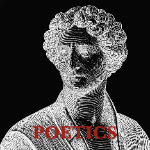
In her comprehensive review of Escaja’s Realidad Mitigada: una experiencia AR (2025), Patricia López-Gay casts a critical eye across both Escaja's text and her creative practice, building a detailed picture of Escaja's decades-spanning artistic experimentations.
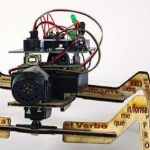
Abhirami Ajith reviews Mark Z. Danielewski's House of Leaves (2000) by tracing the novel's online digital afterlife, dissecting its dissection at the hands of participatory culture, and linking these practices back to contemporary literary theory.
Mehulkumar Desai interviews one of the pioneers of early Electronic Literature and Hypertext Writing, Deena Larsen. The interview reveals Deena's intriguing process of ambiguity and ethics. It shapes Hypertexts beyond a medium to a way of thinking.
Steve Tomasula's Ascension refuses to let the novel sit still, weaving a plethora of multimodal practices into a form that insists reading is a physical, perceptual act. Saidi argues that identity and reality in the novel are never found but perpetually assembled by a reader who cannot remain passive.

If electronic literature does not exist in Wikipedia, it does not exist for AI or search engines either. Larsen issues an urgent call for writers, scholars, and readers to become Wikipedia editors before the field disappears into algorithmic silence.
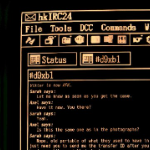
Interface simulations work by making digital tools feel like the ones you already use, but what happens when you actually use those tools for a living? This review tracks how s.p.l.i.t.'s amber-on-black terminal horror turns most convincing precisely where it becomes most uncomfortable for the expert player.
A poem that encrypts itself after one reading, a videogame-poem that exists only in the contingency of play, an augmented-reality sequence that vanished with its platform: Foscolo argues that disappearance is not a problem digital literature faces but a formal principle it has learned to inhabit.
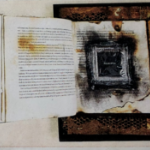
The word "prompt" carries three histories at once: the teacher's assignment, the command line's blinking caret, and the natural-language input to a large language model. This essay reads all three together to argue that prompting is not purely programming but something that sits uneasily in the contact zone between code and natural linguistic expression.

When you read code, you can interpret it, or you can trace it, and these are not the same thing. Arakawa proposes verificational reading as a distinct epistemic practice, one whose validity rests not on critical persuasion but on what the code actually does when it runs.
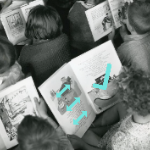
Providing insight into posthuman narrative strategies, Laura Shackleford analyses Steve Tomasula's novel Ascension (2022) for relational points of interest. Who or what is ascending who or what, and to what end?

In this review, Roger Whitson looks into the book Living Surfaces: Images, Plants, and Environments of Media by Aberlardo Gil-Fournier and Jussi Parikka for insight into how the aesthetics of earth can become visible through media mapping.

Mary Shaver cautions budding writers against thinking that their biggest tragedies need to defined their work, and instead offers some alternative exercises to find interesting stories in the mundane.

This essay by Cristina Luli analyzes and compares Steve Tomasula's short story "A Farewell to Kilimanjaro" (1993) to Ernest Hemingway's "The Snows of Kilimanjaro" (1936), bringing to light the embeddedness of media ecology and the materiality of storytelling.
In literature, as in science, how humans emerge remains a continuous matter of engagement. In this article, Claudia Desblaches looks at the emerging scales of human representation in Tomasulas' The Atlas of Man.
Being a reader of Steve Tomasula for the past 30 years means following formally and materially innovative works of art and literature that contribute to a technological reshaping of the posthuman condition. Mary K. Holland, reminded in a waiting room in 2015 of Tomasula's impact on her own critical thinking, reflects on the eerie connections in 'fi about sci, not sci-fi'.