Stone Moons: Hypertext, Resurrection, and Deeply Intertwingled Resonances of Digital Memory

In this perceptive review, Mehulkumar Desai examines Deena Larsen's Stone Moon throughout Larsen's creative journey, first as an unreleased work in Storyspace in the 90s to being released in Twine in 2025. Uniting cultural and archival praxis, Desai's review discusses how we might look at creativity in the technological continuum.
Deena Larsen’s Stone Moons is less a revival of a lost hypertext than an act of resurrection through digital ritual. Originally built in Storyspace between 1995 and 1999, the work remained unfinished due to technological barriers. It re-emerged twenty-five years later through the joint labor of Deena Larsen and the students at Washington State University Vancouver’s Electronic Literature Lab (Claire Leyden, Jenn Nguyen, and Quinn Carrick), who took up the task of transcribing every lexia from the corrupted file into a spreadsheet and reconstructed its intricate network of links in Twine. The 2025 release therefore embodies not only a narrative of maternal struggle and mythic confrontation but also the material history of early electronic literature itself.
The project’s origin story, rooted in Deena Larsen’s friendship with Clarsa McElhaney, a mother fighting for services for her pre-verbal autistic child, underscores its autobiographical urgency. McElhaney’s dictated emails, written “on the fly while running after her child,” became the factual foundation for Larsen’s transformation of lived trauma into fiction. From these communications emerged the figure of Sarah, the mother-protagonist, and her daughter Laurel, whose facilitated-typing exercises would form one of the most ethically fraught and haunting threads in electronic literature. What began as documentation evolved into myth: a desperate mother’s correspondence, transposed into a cosmology where a moon-goddess intrudes on everyday reality, threatening to claim Laurel’s soul as she reaches puberty. Larsen’s mythopoeic instinct turns the bureaucratic and psychological violence of caregiving into something simultaneously cosmic and domestic.
The Twine edition opens with a meta-narrative welcome, an acknowledgment that the work was “originally built in StorySpace (1995-1999) and never published” and that the new version owes its existence to those who “painstakingly resurrected this work from a 1999 corrupted StorySpace file” (Larsen, Stone Moons, 2025). This frame immediately binds technological decay, artistic persistence, and human gratitude into a single gesture. The acknowledgments name the student restorers, Evan Leyden, Jenn Nguyen, and Quinn Carrick as well as Dene Grigar’s Electronic Literature Lab as enablers of rebirth. It is a paratext that doubles as a ritual invocation: the resurrected file is greeted like a revenant.
Central to Larsen’s artistry is her use of hypertext structure as metaphor. For decades, she has argued that meaning in digital fiction arises not merely from nodes of text but from the pattern of their interlinking. In Stone Moons, she describes the architecture through a tactile metaphor: a cup or wine glass, whose bottom, rim, and liquid respectively correspond to the domains of Laurel, and Sarah, and the Moon. Larsen explains that she “picks up a cup, preferably a wine glass,” pointing to its bottom to illustrate Laurel’s world, tracing the rim to signify Sarah’s chronicle, and swirling the liquid to evoke the lunar myth (Larsen 2025). This imagery transforms abstract hypertextual topology into something intimate and embodied. Reading becomes akin to holding the vessel of another person’s memory, one that trembles with the instability of both narrative and emotion.
That vessel’s contents are volatile. The “liquid” of the moon, described as “moon’s blood”, embodies both femininity and danger. As Laurel approaches puberty, her mother’s terror of menstruation, possession, and madness coalesce into an allegory of patriarchal institutions and their bureaucratic cruelties. In real life, the State of Colorado, took custody of McElhaney’s child, charging her with alleged “child abuse.” In the fictional tale, the government becomes a faceless antagonist. In the mythic dimension, it mutates into the devouring moon. The mother’s fear that the state will consume her daughter fuses seamlessly with the myth of the goddess who “enters Sarah’s innermost fears” (Larsen 2025).
The Twine adaptation sustains this allegorical density through deliberate fidelity to 1990s aesthetics. The student team chose to maintain “the pixelated look” of the original images and the color palette of mid-resolution screens. Their decision respects the historical texture of the artifact, allowing the reader to experience the material constraints of the period as part of the narrative atmosphere. The slight grain of the graphics, the limited fonts, and the spacing of text evoke a time when digital storytelling was still uncertain of its own body. The resurrection, therefore, is not a cosmetic upgrade but an act of historical empathy, an attempt to preserve the aura of a fragile medium.
From a structural perspective, the Twine version re-implements Storyspace’s multi-destinational links, those that allowed one phrase to open several possible paths, by simulating the same ambiguity through layered passages. In the original, the link phrase “she’ll get better” could lead to three different destinations: a hopeful node, a spiritual one, or a despairing critique of the school system. This multiplicity of outcomes transforms link-labels into narrative agents; their semantic charge colors whichever text follows. The Twine engine, less natively polyvocal than Storyspace, required the restorers to emulate this mechanic with conditional code. In doing so, they preserved Larsen’s principle that each link functions as a micro-narrator, a whispering voice that biases interpretation before the reader even clicks.
Such link rhetoric is crucial to understanding the humor that ripples beneath the work’s somber surface. In both Samplers (1996) and Marble Springs (1993), Larsen deploys playful link labels and puns to create counterpoint to dark subject matter; Stone Moons continues that strategy. Larsen’s presentation at ELO notes that “Larsen created a humorous layer to offset the mostly dark story.” These jokes, pun-based or allusive, often rely on 1990s North American idioms, early internet puns, or domestic ironies that may puzzle contemporary or non-Western readers like me who are not familiar with the references. A phrase like, “They promise classes; they give closet space” operates as a bitter satire of special-education bureaucracy but depends on understanding the institutional euphemisms of the U.S. public-school system. Readers like me from the Indian subcontinent, encountering these quips decades later, might find them opaque or oddly trivial beside the mythic gravitas of the lunar scenes. Likewise, references to Pepsi or Doritos, which Laurel’s mother notes “the moon definitely does not want,” read as cultural relics of American consumer humor. For Indian readers used to different registers of irony and domestic symbolism, these moments can seem distant, even alienating. Yet, that very disjunction reveals something essential about Stone Moons: its humor is a defensive gesture, a micro-resistance against overwhelming systems, much as the Twine reconstruction itself resists technological obsolescence.
The difficulty of comprehending these jokes across cultural and temporal boundaries underscores a broader issue in digital-humanities reception. Stone Moons was born within the early internet culture and hypertext fiction writing conventions (such as the “Eastgate School” of complex interlinking text nodes and links) of the mid-1990s (Flores 2019). American academia and domestic computing culture, dial-up modems, mail-list communities, and the poetics of the hyperlink. Its humor drew from those worlds: sardonic, self-referential, ironic about its own code. To an Indian reader encountering Stone Moons today, such jokes demand translation not only of language but of affect. The “cup” metaphor might resonate with universal imagery, but the textual play of bureaucratic acronyms or Western food brands requires contextual gloss. Rather than marking failure, this opacity opens new interpretive potential: readers from outside the original milieu can see in these dated gestures an archaeology of global digital modernity, the moment when “hypertext” was a Western promise rather than a universal medium.
Beyond humor, Stone Moons operates through emotional and mythic resonance. Its mythopoesis merges Greco-Roman lunar symbolism with domestic ritual. The moon-goddess, a fusion of Selene, Artemis, and an invented maternal demon, intrudes upon Sarah’s reality much as data corruption infiltrates the hypertext file. Deena Lrasen’s ELO talk on Stone Moons account of the original corruption, that the Storyspace file grew “too large for its program” and died, is not merely technical but allegorical. The software’s collapse mirrors the mother’s exhaustion and the moon’s consuming overflow. Larsen’s later note that “the moon’s blood flooded the land” reads retrospectively as commentary on the very system failure that destroyed the file. The literal overflow of code becomes a metaphor for emotional surfeit.
The resurrection process, documented in Deena Larsen’s ELO talk and reflected in the spreadsheet, becomes a second narrative superimposed on the first. Student transcribers, switching between an aging 1997 computer and modern devices, re-entered each node and link by hand. Their spreadsheet captures not only text but also the logic of connections, multi-destinational routes, color schemes, and contextual cues. The act of retyping thus becomes an ethical gesture akin to caregiving: patient, attentive, repetitive, and devoted to recovery. When the Twine edition thanks them by name, it performs an inversion of the work’s own theme, where once a child was lost to institutional custody, now a work is restored through institutional care.
Larsen’s decision to release the 2025 version publicly as a creative commons attribute (CC BY) on her website rather than through a commercial publisher continues the ethos of accessibility and community that defined early hypertext circles. The Twine interface’s opening text, “Welcome to the Twine version of Stone Moons,” addresses the reader directly as “dear explorer,” situating them within a lineage of interactive reading that began with her analysis of early hypertext works in her 1991 thesis, Hypertext and Hyperpossibilities(1992) such as William Dickey’s hypercard works that experimented with hidden linking navigation, Izme Pass, and Judy Malloy’s Its Name was Penelope. Yet, the tone is more intimate and elegiac than the precursors. The reader is not merely navigating but participating in a memorial ritual for a “stillborn, dead work” that has now been “brought into a new light” (Larsen 2025). This self-conscious mourning for a digital past situates Stone Moons at the intersection of narrative, autobiography, and media archaeology.
Technically, the Twine edition modernizes the navigation but preserves the bottle structure. Each node corresponds to one of four realms: Sarah’s Reality, Deeper Wars, Laurel, and The Moon. The reader’s traversal across these layers generates meaning through rhythm and juxtaposition. Repetition, of motifs like “blood,” “light,” “law,” and “letters”, produces an incantatory cadence, echoing both bureaucratic repetition and liturgical prayer. When read continuously, the text suggests not linear progression but cyclical compulsion. In this sense, the Twine engine’s simple transitions, fade, dissolve, replace, echo lunar phases, each click a waxing or waning of narrative illumination.
At a deeper theoretical level, Stone Moons redefines what preservation means for electronic literature. Traditional textual preservation seeks stability; digital preservation acknowledges change. The Twine version does not replicate the Storyspace original but rather performs its history of loss and repair. Its pixelation, occasional broken links, and meta-commentary on corruption are part of its aesthetic. As Larsen’s presentation at ELO notes, “Twine did not offer a way to recreate these interstitial navigational asides embedded in link names,” forcing the team to invent approximations. Indeed, as Larsen explains, the main navigational aid for The Moon, Sarah’s Reality and Deeper Wars was corrupted, and Larsen rewrote an approximation for these narrative navigations in 2025. The absence becomes expressive: the gaps where Storyspace’s features could not be emulated act as scars, visible seams of resurrection.
That scarification is thematically apt. The narrative’s central tension, between protection and autonomy, body and soul, echoes the digital object’s own vulnerability. The mother who fears her child’s possession by the moon mirrors the author who fears her work’s loss to obsolescence. Both must eventually let go. The Twine edition, by existing in the open web rather than proprietary software, enacts that release. It accepts that survival depends on translation and that translation entails transformation.
Reading Stone Moons today, one experiences an uncanny layering of time: the 1990s cultural matrix of early hypertext interfaces and the cultural and institutional barriers surrounding severe autism; the early-2000s dormancy of the corrupted file; the 2023—25 resurrection in a university lab; and the reader’s present encounter mediated by Twine’s minimalist interface. This temporal palimpsest produces an effect somewhere between nostalgia and defamiliarization. For scholars of electronic literature, it exemplifies how the field has matured from experimentation to curation, from avant-garde exploration to archival ethics. The work’s “stillborn” self-description, once tragic, now reads as emblematic of an entire generation of digital art that needed decades to find its stable form.
Yet, despite its archival frame, Stone Moons is profoundly alive. Its emotional power arises not from technological novelty but from its sustained empathy for human fragility, the fragility of mothers, children, machines, and memories alike. Larsen’s careful blending of myth, documentation, and self-referential form renders it one of the most complex treatments of disability and motherhood in the electronic-literature canon. Through the act of hyperlinking, she stages care not as sentiment but as structure: every choice opens paths for understanding or misreading, echoing the ethical uncertainty of real-world caregiving.
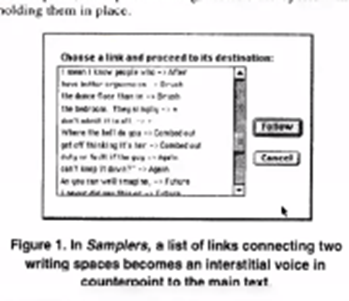
Indeed, most importantly, Stone Moons provides a technological path forward for Twine. Larsen’s original work was a more deeply imagined instantiation of her storytelling within the links as noted in her collection of nine vicious little hypertexts, Samplers, 1996 (Bernstein 1998). Bernstein characterizes this as “Larsen has chosen links itself to be read as an interstitial pattern” The original screenshot from Samplers exemplifies Larsen’s narrative linking technique:
Most of the humor and meaning in Stone Moons relies on multiple destination links, each with a text name for the link. This intricate and deeply intertwingled storytelling needs to be explained as it is the foundation for the work. Like foundations, it must be excavated as a close reading. In the node “Catch 22,” for example, the link on “the last battle” brings up a navigation pane. These panes were an integral part of the Storyspace program, and Larsen’s students innovatively created code for Twine that mirrored this fabulistic link function. Hence, this recreation celebrates the legacy of the original Storyspace program, rising beyond all the challenges to bring the work back to life. In the process, it vividly underscores the archival expertise and precision of Dene Grigar and her team at the Electronic Literature Lab, whose successful resurrection of the work in new software is clearly evident in their preservation of its 1990s screen aesthetics and original structures intact.
Stone Moons heavily linked pages create the humorous shadows needed as contrast for the heavy content as Sarah battles the Moon for Laurel’s soul and the educational and social system for Laurel’s body. Moreover, they undercut meaning, provide ironical asides, and shed light on the complexity of the worlds and relationships between Sarah, Laurel, and The Moon. In Catch 22, here, the link is on “the last battle.” In the text itself, this term refers to the latest contretemps between Sarah and the red tape breathing dragon of Social Services, refusing to pay for Laurel’s physical and mental needs. But the link’s textual navigation tells of a very different last battle—between Sarah and the Moon for Laurel’s very soul. And, while the tone is meant to be humorous, the ironic message (presumably from Sarah or perhaps Larsen herself) suggests that sometimes the battle is indeed futile.
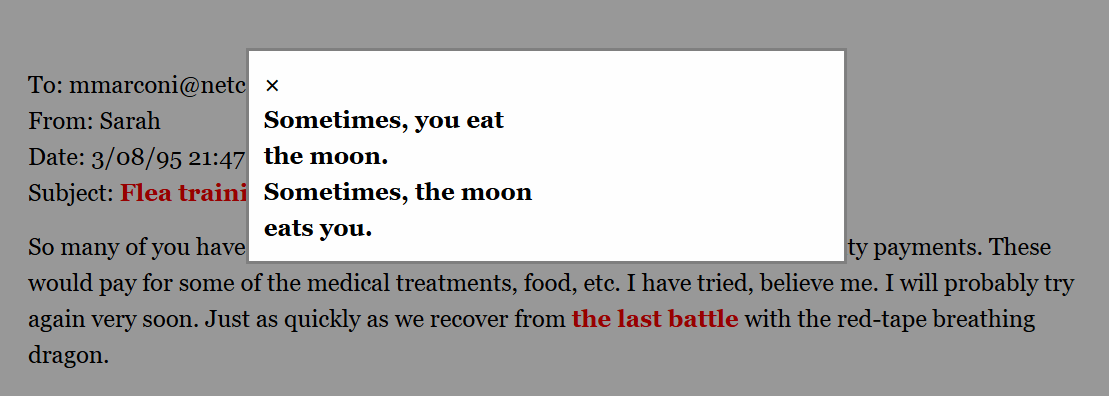
Moreover, these links color the destination nodes as well. For example, “Sometimes, you eat” goes to the node “My chains” which details the overwhelming and impossible documentation needed for Sarah to get money to eat. Coming from the Catch 22 (a term for impossible circumstances) to another unreachable institutional requirement provides yet another ironic note that, no, sometimes you don’t eat.
This reading gets us deeply under the hood. You must download and save the Twine work and open in Twine to reveal the link destinations:
''the last battle''

Sometimes, you eat -> (link-goto: "My chains")

the moon. -> (link-goto: "Yanking")

Sometimes, the moon -> (link-goto: "leave her again")

eats you. -> (link-goto: "Leaving")
This oscillation of main text illumination and shadow link text structures the narrative itself: each node, like a moon phase, reveals only a partial illumination of the whole. The hypertext thus enacts a “lunar narratology,” where movement through the work mimics the rhythm of waxing and waning, knowledge appears, recedes, and reappears in altered form. The reader’s progress (and indeed the authors’ struggles) are less linear discovery than cyclical re-encounter, a process akin to what Espen Aarseth describes as ergodic labor, meaning produced through navigation rather than mere interpretation.
In conclusion, Stone Moons (Twine 2025) stands as a monumental instance of what digital humanists now term “media palimpsest,” a text whose meaning arises from its successive layers of inscription, corruption, and recovery. It unites late-20th-century feminist hypertext poetics with twenty-first-century archival praxis. For new readers encountering it outside its original cultural context, its humor may seem elusive and its bureaucratic details foreign, yet the broader resonances of love, fear, and persistence remain immediately legible. The resurrection of Stone Moons is therefore not only the recovery of a lost file but the continuation of a conversation about how stories survive through technology, community, and care.
Works Cited
Bernstein, Mark. Patterns of Hypertext. Eastgate Systems, Inc., 1998. “Bernstein M- Patterns of Hypertext.” Scribd, uploaded by Giuliana Arcidiacono, 1998, [https://www.scribd.com/document/599869347/Bernstein-M-Patterns-of-Hypertext]. Accessed 15 October 2025.
Flores, Leonardo. “Third Generation Electronic Literature.” Electronic Book Review, 7 April 2019, [https://doi.org/10.7273/axyj-3574].
Larsen, Deena. “Hypertext and Hyperpossibilities.” MA thesis, University of Colorado, 1992.
—. Samplers: Nine Vicious Little Hypertexts. Eastgate Systems, 1996.
—. Stone Moons (Twine Edition). 1 June 2025. [http://www.deenalarsen.net/stone/].
—. Stone Moons (1995-99), exhibited in “Love Letters to the Past and Future: The ELO25@2025 Juried Exhibition.” ELO25 @ 25: Love Letters to the Past and the Future, Electronic Literature Organization, 11—13 July 2025, York University, Toronto.
Cite this review
Desai, Mehulkumar. "Stone Moons: Hypertext, Resurrection, and Deeply Intertwingled Resonances of Digital Memory" electronic book review, 24 April 2026, https://doi.org/10.64773/2ju4-vi42