A Research Assistant's Story
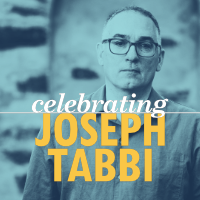
In his speech from Joseph Tabbi's festschrift in May 2025, Daniel Johannes Rosnes discusses his brief time spent working with Tabbi, covering the trust and responsibility he was immediately offered to the importance of Tabbi's view of publishing as a collaborative effort, formed by a "network of people".
“I want to start off by introducing myself, especially to those I have not had the pleasure of working with here at the University of Bergen and the Center for Digital Narrative. My name is Daniel Johannes, and I have been working with Joe for the last two years, mostly on ebr, where he is my editor in chief, although I do a little bit of everything. I got my start as a research assistant, but my current title is actually “consultant”, and as people rarely ask me to consult on matters, I guess I have a pretty cushy job.
I’m going to try and keep this brief, since, unlike many of you here, I have not had the pleasure of knowing Joe for a long time. When Joe founded ebr in 1995 with Mark Amerika, I was negative 3 years old. I was born around the time of ebr 7 in the summer of 1998 (image + narrative part 2, guest edited by Steve Tomasula and Anne Burdick). I first met Joe in the summer of 2023 after applying for a job as a research assistant: it was mostly editorial work, and mostly ebr-focused, and as I had somehow gotten it into my head that this academia stuff might be something I might want to do, I figured I should throw my hat in the ring. I got lucky and was invited to a job interview with Joe, which was perhaps the least conventional interview I have ever been to — and considering I absolutely hate job interviews, that’s a compliment.
I want to give a quick rundown of the interview to give you a sense of how I came to know Joe: Things started normal, we went through some questions about my previous experience, we talked about the position and our lives, and when the interview was wrapping up Joe handed me a thick stack of documents, mostly related to ebr; works in progress, procedural documents, etc. If you’ve worked with Joe then you are probably used to being handed stacks of paper on a regular basis, but at that point I was not prepared. My first thought is that it must have meant that I aced the interview and I was already being welcomed aboard, but that quickly gave way to doubt; what if this is how he tries to woo all the prospective candidates, with thick stacks of paper, and what if I’m not special?
A few days later, I was offered the job. Working on ebr with Joe, I was struck by the level of responsibility and trust I was given from day one. I was of course used to working, but I was used to the kinds of entry-level, dead-end jobs where you are only given as much responsibility as you would give to your child when they are home alone.
Now I want to move on to what I have learned from Joe, and perhaps what we could all stand to learn from Joe. I think what makes working on and what makes ebr great is that Joe has run the journal with the same level of trust, openness, and playfulness as I was offered when I first joined.
Another thing we can learn from Joe is his almost supernatural ability to create connections, as you can tell from all the people gathered here today. This is also something I picked up on while working on ebr, all the varied and impressive people that have published in our journal, that Joe could always tell me so much about. Joe always stressed that ebr was more than just a journal; it was a network of people, sharing their ideas and working towards something, something bigger, something important. In today’s increasingly polarized media climate, where we are always surrounded by people but making genuine connections is becoming more and more difficult, using technology to bring people together rather than driving us apart for profit is more important than ever. From inviting diverse scholars to host gatherings to soliciting riPOSTe’s (and to the lone priPOSTe’s that were only used once by Scott to respond to something in pre-publication – sometimes the discourse gets so lively it can’t even wait for essays to hit the press.) And sometimes it is just about offering people a space to talk about the things they care about that they can’t always publish elsewhere. Joe is not afraid to do things differently, and in a world where academic publishing is increasingly becoming homogenous, for-profit operations, offering an alternative to that is more important than ever.
The final thing I want to talk about today is the latest project I have been working alongside Joe on, which is the collection we’re doing on Joe and ebr at 30 for the special collections at the university. You will find some of the items in the pamphlets that we have, hopefully, distributed in a way that makes sense. From Black Ice Number 7 to The Unknown, to the Markson letter that says: “Come back Joe. Joe? Joe? Joe?” I think this collection of artifacts tells the story of Joe through his connections, and while you shouldn’t diminish his individual accomplishments, I think it’s these connections that have made Joe special. And I think that’s what I want to end on, that we are all here because of Joe, but I don’t think Joe would be here either without all of you.
Thank you.”
Cite this essay
Rosnes, Daniel Johannes. "A Research Assistant's Story" electronic book review, 18 January 2026, https://doi.org/10.64773/3154-d663