Joe Tabbi as Literary Scholar and Cyberpunk
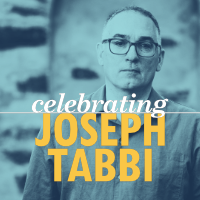
In a print version of his speech given at Joseph Tabbi's festschrift, Nick Montfort discusses Tabbi’s instrumental role in the understanding of index-card-based composition and collaborative glossary development. In doing so, Montfort both contrasts and connects these two disparate means of writing, while arguing that Tabbi led a second life as a cyberpunk, thanks to the founding of ebr.
“As you can see, we’ve had our eye on you for some time now, Prof. Tabbi. It seems that you’ve been living two lives. In one life, you’re Joseph Tabbi, literary scholar for a respectable university. You have a National ID number, you pay your taxes, and you … help your community understand postmodern writers who have written books. The other life is lived in computers, where you go by the hacker alias ‘Joe’ and, in a so-called ‘book review’ that you founded and edit, give credence to all sorts of things that aren’t books at all.”
“Joe” — as we can call him — has offered us insights into many important American writers and their works, and has explored the edge cases of form and genre. He helped us understand how David Markson wrote, for instance, with index cards for note taking and to feed into the composition process. And he’s long advocated for and developed glossaries. So even if we keep to the respectable life of Prof. Tabbi, literary scholar, what do index cards with strange factoids — and glossary entries packed with conceptual power — have to do with each other?
Markson composed literary works with the help of index cards, a different idea than publishing something as a deck or set of cards.1 I’ll explain how Tabbi’s discussions of and with Markson have shed light on the fragmentary writing that results, beginning with a 1990 interview and continuing into the chapter on Markson in his book Cognitive Fictions (2002). From there I’ll seek to make connections between card-based composition and conceptually powerful glossaries, specifically, the one that Tabbi is continuing to gathering for his Cambridge Introduction to Literary Posthumanism (2024).
Because I focus on the material nature of composition and how it relates to fragmentary literary texts, it’s not in the cards for me to discuss work inspired by or taking the form of tarot or playing cards, however interesting.2 It’s important, too, to distinguish cards meant to be ordered from those meant to be shuffled. Playing cards and tarot cards may remain in a shuffled state, but cards for reference are ordered. When used in composition an author’s notes may be organized while phrases that are woven in a novel’s text can be rearranged.
Glossaries need to provide readers the ability to look up terms, as do ordered index cards. They are about properly speaking and understanding terminology, the way that a specialized vocabulary relates to concepts. Each entry may vary in length by more than a card would allow.
Index cards were invented in the United States — independently, long after their invention in Europe — to facilitate the indexing of the Harvard College Library (Krajewski 2011). Users could flip through cards in library catalogs, although they were secured, via a punched hole and a long rod, in alphabetical order. Such cards are also often used to hold recipes and best kept in order. In those cases they may be pulled out for inspection during cooking. But enough of their intended uses; let’s continue to consider their misuses, particularly in American letters,3 particularly by Markson.
As exhibited in Wittgenstein’s Mistress, but also in his last four books, known as the Notecard Quartet,4 “David Markson was an inveterate card shuffler. He kept notes on index cards. Facts like: Guy de Maupassant ate his lunch every day at the Eiffel Tower so that he didn’t have to look at the Eiffel Tower when he ate his lunch” (Morales 2004).
Of reading Wittgenstein, Markson told Tabbi: “It can be an ordeal. As if he stutters when he writes.” He said he developed a more supple style for the protagonist and single character in the book, Kate. “And yet,” Markson continued, “the novel is at least superficially similar to the Tractatus by way of all those short paragraphs too and with the frequent sequences of variants that go through Kate’s mind on a single idea” (Tabbi 2013).
Wittgenstein’s other books also relate. Wittgenstein himself may have written in note books and eschewed cards of industrial, regular size, but other work of his is assembled out of brief remarks. One of his posthumously published books, consisting of brief remarks, is entitled Zettel (“Slips of Paper”); The posthumous publication with his final writings, On Certainty, is similarly fragmentary.
While Wittgenstein’s fragments are clearly conceptual, he describes the world as composed of facts, which we might understand as brief when stated. “According to Wittgenstein’s … Tractatus … ‘The world is everything that is the case’ and ‘What is the case, the fact, is the existence of atomic facts.’ Markson puts together a collage of atomic facts from his index cards.” (Morales 2004) However, as Tabbi elicited from Markson, it’s not just the sequence of facts that makes Wittgenstein’s Mistress the book it is. “The Wittgenstein is frequently most obvious in the very way she [Kate] questions so many of her own ‘propositions,’ as it were” (Tabbi 2013). This is the effect, connected directly to a method of writing shared by these two: “Like Wittgenstein over years of writing (and through recurrent extended dry spells), Markson evolved a nonsequential method of composition that breaks the work into distinct lexical units of at most a paragraph or two” (Tabbi 2002, p. 106). Tabbi notes that this lexia-like chunking of text (2002, p. 1117) was contemporary with hypertext; Indeed, it’s provocative to consider that Wittgenstein’s Mistress and Reader’s Block are more specifically contemporary with the beloved Apple software HyperCard.
Tabbi takes his discussion of Markson’s terse factual statements much further in Cognitive Fictions, considering how the characters’ writing (typing) of these interacts with their thinking about them. In this short and non-philosophical investigation, however, it’s enough to note that most of the texts in Wittgenstein’s Mistress and the Notecard Quartet do seem to be about simple (atomic) things that may be the case or not, questioned or not. A format that has more potential to be expansive is that of the glossary, which in its fullest form elaborates complex concepts and connects them to terms.
To start with the truly minimal glossary, a bare word list or lexicon which can be used for orthographic discipline but does not indicate anything about conceptual or semantic matters: Wittgenstein himself wrote one of these, Wörterbuch für Volksschulen [Dictionary for Elementary Schools], which was 42 pages long, and had just fewer than 6,000 entries. It was published in 1926, the same year he left teaching after causing a student to collapse with a severe blow (Weber 2019). This makes this basic glossary, which doesn’t seem to be composed of either facts or concepts — just words — the only other book, besides the Tractatus, that Wittgenstein published in his lifetime.
Wittgenstein developed what has come to be known as the “private language argument” in Philosophical Investigations — an argument that it is impossible to have a language intelligible to a single speaker (or thinker) of that language. At the same time, he seemed to find the solitary development of his word list to be perfectly suitable. Not a contradiction, of course, but still.
During his time as president of the ELO, Tabbi started a glossary for the Electronic Literature Directory, explaining concepts important to born-digital literary art in a very natural way: Online. The terms were also glossed collaboratively, rather than by a single author (with a potentially private language). Joe also never beat a student down onto the ground, by the way, so he was superior to Wittgenstein in a few ways.
Even as we hurtle down the Infobahn in 2025, we academics are still very likely to find glossaries at the end of books. These declare that language is used in specialized ways in different fields, or even within a particular monograph or collection. Such glossaries can be written by a single person5 or can be collaborative, with contributions from many people in the field who are particularly interested in certain topics and concepts.6
Tabbi concludes (or rather, hands off) his Cambridge Introduction to Literary Posthumanism quite brilliantly — with a glossary that has very substantial entries about literary posthumanism, written in this collaborative way, and is open to expansion. He explains, crediting an important recent predecessor glossary, why the glossary form remains important while the solitary or closed mode of its composition will not do:
The foregrounding (for example) of an individual author or long-term collaboration among coauthors within and among established disciplines: this is unlikely to be the default mode of our present posthumanities. A quite different model emerges, for example, from the 160 keywords and field-defining concepts compiled, contextualized, and carefully coedited by Rosi Braidotti and Maria Hlavajova in their Posthuman Glossary. Unlike Abrams [author of a literary humanities glossary published in 1957], Harpham [who helped update Abrams’s glossary in 2005], and most other predecessors in the literary humanities, Braidotti and Hlavajova work collaboratively on the identification and description of keywords and concepts that are thought, by others, to be of relevance to the emerging posthumanist discipline. The invited authors, notably, are a mix of established and early career scholars who collectively make up an emerging literary field (and an alternative institutional framework). The multiauthored assemblage brought together by Braidotti and Hlavajova signals a departure from the humanities that Samuel Johnson initiated and Abrams and Harpham advanced. (Tabbi 2024, p. 163)
What a powerful and posthuman way of thinking about the venerable humanities! Why not have a group of people, passionate about different concepts, help load them into our minds, even before we begin reading a book where the corresponding term will be deployed? After attentively reading an entry in the Cambridge Introduction to Literary Posthumanism, we might have at least a hint of the feeling that Neo did in The Matrix: Not “I know kung-fu!” but “I know plasticity!”7 At the very least, we’re ready with some key ideas that will unlock new understandings.
Starting from isolation, facts, and lacunae (which can be artful, à la Markson, and rigorous, à la Wittgenstein), we can grow to appreciate the intellectual power of collaboration, concepts, and connections: Seen very clearly in the collaborative glossaries Tabbi has started and helped to develop.
But back to The Matrix: I’ve already noted that in his work beyond books, Joe served as president of the Electronic Literature Organization. That was during the time that first volume of the Electronic Literature Collection (which I co-edited with Scott Rettberg, Kate Hayles, and Stephanie Strickland) was published. I was honored to serve as ELO president after Joe, and was pleased that the Organization was sustained in great shape at this point, despite the challenges of moves from UCLA to the University of Maryland to MIT. Years before the ELO was established in 1999, though, you can see Joe’s cyberpunk aspect in his work as a publisher. If you take a look at the first issue of ebr, from 1995, you’ll see that it looks like the Electronic Kool-Aid Acid Book Review, with articles about Bruce Sterling’s Dead Media Project and body modification. It’s no surprise the publication was praised in hipper-than-thou Details magazine the year after it launched. The surprise is that long after the demise of Details, long after the last issue of Mondo 2000 (“the only magazine with an expiration date in its title” ---Bruce Sterling), Tabbi’s ebr is still going strong and remains at the cutting edge of culture and computing.
Glossary
glossary (n). A list of specialized terms which may include information about how they are pronounced and used. One will typically explain how these terms correspond to important concepts in a field.
index card (n). An industrially produced rectangular card of regular size, intended for the indexing of items, for recipes to be written upon it, etc. These can be misused for exercises in writing classes or by professional writers who write notes or fragments of prose text on them.
Markson, David (1927—2010). American experimental novelist and innovative user of index cards.
Tabbi, Joseph (1960—). American literary biographer, scholar, editor, and leader in promoting electronic literature, literary posthumanism, and the collaborative development of glossaries.
Wittgenstein, Ludwig (1889—1951). Austrian analytical philosopher and children’s lexicographer.
Works Cited
Grenier, Robert. Sentences. Iowa City: Whale Cloth Press, 1978.
Krajewski, Markus. Paper Machines: About Cards & Catalogs, 1548-1929. Cambridge, Mass. & London: MIT Press, 2011.
Montfort, Nick and Zusana Husárová. “Shuffle Literature and the Hand of Fate.” electronic book review. August 5, 2012. https://electronicbookreview.com/essay/shuffle-literature-and-the-hand-of-fate/
Morales, Jorge. “A Review of: Vanishing Point by David Markson.” The Believer, July 1, 2004. https://www.thebeliever.net/david-marksons-vanishing-point/
Tabbi, Joseph. Cognitive Fictions. Minneaplois and London: University of Minneapolis Press, 2002.
Tabbi, Joseph. “A Conversation with David Markson By Joseph Tabbi.” Dalkey Archive. August 2, 2013. https://www.dalkeyarchive.com/2013/08/02/a-conversation-with-david-markson-by-joseph-tabbi/ (Originally published in the Review of Contemporary Fiction, Summer 1990, 10.2.)
Tabbi, Joseph. The Cambridge Introduction to Literary Posthumanism. Cambridge & New York: Cambridge University Press, 2024.
Weber, Désirée. “Only a dictionary makes it possible to hold the student completely responsible.” Wittgenstein Initiative. August 20, 2019. https://wittgenstein-initiative.com/wittgensteins-dictionary-for-elementary-schools/
Wershler, Darren, Lori Emerson, and Jussi Parikka, The Lab Book: Situated Practices in Media Studies. Web page associated with the book published by the University of Minnesota Press. Under the heading *“*A Glossary of Lab Techniques---Extending The Lab Book.” 2022. https://manifold.umn.edu/projects/the-lab-book
Footnotes
-
Robert Grenier’s Sentences consists of 500 notecards, contained in a box, each with a terse text that was originally typed upon such a card. So, unusually, it was both composed on cards and presented in that format. One of these gives the title to Paul Stephens’s book on minimal writing: “absence of clutter.” There’s an irony: While a single card with this typed phrase at its center is anything but cluttered, an attempt to read Sentences is likely to result in cards dealt over the table in various configurations, ones that may be and almost certainly will be placed back into the box in a different order. ↩
-
That means this sentence will be the only one that mentions the wonderful “Heart Suit” by Robert Coover, printed on a subset of a deck of playing cards and meant to be shuffled, with the first and last one held constant. A collaborator and I have already discussed how some literary works exist and cards or sheets meant to be rearranged --- indeed, in an article published in the journal Tabbi co-founded and edits, ebr (Montfort and Husárová 2012). ↩
-
I couldn’t find a place to put this card-sized comment, but there are plenty of notable American writers who have used index cards very directly in composition. One is Vladimir Nabokov, who references the practice in Pale Fire. ↩
-
Reader’s Block (Dalkey Archive, 1996), This is Not a Novel (Counterpoint, 2001), Vanishing Point (Shoemaker & Hoard, 2004), The Last Novel (Shoemaker & Hoard, 2007). ↩
-
This person might be someone hired specifically to be the glossary writer, or an author or editor of the book. ↩
-
In addition to having written and having written the first draft of entire glossaries, I also contributed two entries to the open-ended, collaborative glossary of The Lab Book (Wershler, Emerson, and Parikka, 2022), one of which was a collaboration. My enthusiasm for glossaries, further bolstered by Tabbi’s work, leads me to read them before the main text when books include them --- and even to assign my students to do the same. ↩
-
Remember that even the preternaturally gifted Neo was not ready to defeat Morpheus right after a single training module; he didn’t know everything there was to know about kung-fu. A glossary entry, however, does seem a great way to prime a reader and thinker for engagement with terms that are woven through longer discussions. ↩
Cite this essay
Montfort, Nick. "Joe Tabbi as Literary Scholar and Cyberpunk" electronic book review, 18 January 2026, https://doi.org/10.64773/3658-499e