Lessons Learned About Jo[e/seph] Tabbi
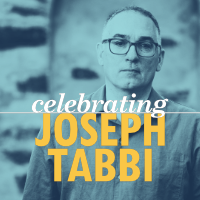
In her speech, originally given at Joseph Tabbi’s festschrift, Tegan Pyke details how she met Tabbi and became a part of two of his key knowledge infrastructure projects. Discussing Tabbi’s innate ability to connect with people and collaborate, Pyke frames community building as a vital part of Tabbi’s academic legacy.
“Before I came to the University of Bergen two years ago, I’d heard of Joe Tabbi. Or, rather, I’d heard of Joseph Tabbi, the scholar. When you arrive in the field of electronic literature, it’s almost impossible not to. His name is one of the many that have been integral to its construction.
Of course, recognising a name and respecting the research output attached to it is entirely different to knowing a person.
To know someone, I feel, you have to meet them.
So, how did I first meet Joe?
I first met Joe at a research group meeting. A research group meeting I was incredibly nervous about and, somehow, managed to unintentionally monopolise with an introductory presentation that went on far too long. At the end of this meeting, despite my rambling, Joe asked if I wanted to meet for a chat. My immediate answer? Yes, of course!
A little under a week later, we met. Actually, we had coffee at BKB, a little coffee place in Møhlenpris that has become my favourite coffee shop. And, on the walk back to the university, he pointed out Nopel Bopel, which is my favourite place for drinks.
This was my first lesson learnt about Joe:
He has great taste in venues.
During that meeting, we discussed what felt like a little bit of everything, including but not limited to: the role of community in academia and literature—a topic I’ll be returning to; the importance of these connections and their role in connecting ideas in scholarship; the roles of archival and documentation, of definition and terminology.
Less than two weeks later, somehow, I was creating documentation for the Living Glossary of Digital Narrative, Joe’s project in collaboration with the University of Stuttgart.
Two months after that, I was working on electronic book review.
This was my second lesson learnt about Joe:
You won’t know you’re a part of one of his projects until it’s too late.
Two years later, I’m still in deep: sifting through the decades of articles in electronic book review’s back catalogue just to make sure they’re formatted correctly, making list after list of changes to be made and questions to be asked, sliding into people’s inboxes asking for peer reviews, jumping for joy in the middle of the office when I’m contacted about a new gathering.
Why?
Because I’m in awe of what Joe—and the community Joe has created and re-created, over and over again—has accomplished. It took real foresight and real belief in the cyberutopian dream, to start an online, open access journal in 1995, when the Web itself was in the early stages of uptake from a global audience. It also took real dedication and perseverance to have stuck withthat journal year after year after year. For decades. Especially when, as Rob Wittig has told me, the department Joe worked within when ebr was founded had zero belief in the project, providing no support and only resistance. In less than a month, I turn 35—the same age Joe was when electronic book review debuted, as you will know if you’ve read your pamphlet—and I can’t say, if I’d been in the same position, that I would have shown the same determination, the same sheer level of grit, even with the collaborators and conspirators I know Joe had.
So, third lesson learnt about Joe:
Don’t let the softly spoken part fool you; he can be stubborn as all hell.
But that stubbornness is not something I’ve encountered often. Actually, the Joe I’ve come to know is a person marked by an openness to new ideas and the contributions of others. Which, I think is—to use one of Joe’s favourite words—a sublime reflection of the scholarship of Joe’s that I find the most joy in.
In Norway, there’s a term that often comes up regarding scholarship: the “red thread”, which is a recurring theme. Joe’s scholarship has multiple threads but, in my opinion, the defining thread for the last thirty years, at least, has been collaboration.
I think a testament to that is the people who have flown internationally to be here today or sent their well-wishes from afar. There aren’t many people on this planet who can attest to having a truly global, international network, but Joe Tabbi has achieved just that.
So, I would like to say: Thank you, Joe, for inviting me to be a part of it.
And here’s to many more years of Joe Tabbi, extraordinary node in an extraordinary network.”
Cite this essay
Pyke, Tegan. "Lessons Learned About Jo[e/seph] Tabbi" electronic book review, 18 January 2026, https://doi.org/10.64773/e3b4-073d