Two or Three Things I Know About the Early History of the electronic book review and How Joe Tabbi and I Brainstormed Its Inception
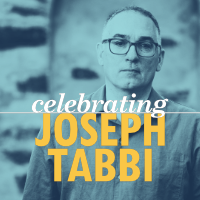
In ebr co-founder Mark Amerika's speech from Joseph Tabbi's festschrift—originally given at the University of Bergen, Norway—Amerika explores the founding of electronic book review, the radical foresight Tabbi provided, and the journal’s links to post-publishing practice. As part of this, Amerika poses Tabbi's legacy not as something fixed, but as a challenge of continuing reconceptualization.
First, we didn’t really know what we were doing.
I don’t mean the creation of ebr was all dumb luck. On the contrary, as none other than Louis Pasteur once said, “Chance favors the prepared mind.” And Joe and I were prepared, at least to some degree. We had a common set of interests: postmodern literature, poststructuralist philosophy, and this new technology that we thought would change everything: the Internet.
But our relationship, and the evolution of ebr, started with books.
So, let’s take a short trip inside the Way Back Machine:
To be specific, let’s go back to the early 90s. In 1993, Black Ice Books, a paperback imprint of FC2 (Fiction Collective) that grew out of Black Ice magazine, an avant-garde literary journal which I edited with the late, great, postmodern impresario, Ron Sukenick, was launched at the 1993 Vanguard Narrative Festival at Brown University. It was there that we began “promoting” i.e. strategically positioning the books we were publishing as part of a new literary art movement that we called Avant-Pop—look it up. When, after the Brown event, Ron and I got back to our respective writing studios in Boulder, Colorado, we decided to send all four of these Avant-Pop / Black Ice Books to a few Avant-scholars of the time, of which there were not many, one of whom we had already been in touch with and who had already started making a name for themselves in a little town in Kansas called Manhattan—the other Manhattan, the one where Kansas State University was located. The one where Joe Tabbi resided at the time.
Joe being Joe, he was totally open to receiving the books and an engaged correspondence followed.
Meanwhile, in late 1992, parallel to all of this book and magazine publishing, just as we were finishing production on the first set of Black Ice Books, which would soon to be launched at Brown—I founded Alt-X, an online publishing venture that came into being before there was a web-based graphical user interface with in-line graphics (that would happen in April of 1993). Alt-X, that’s still available as a living archive at altx.com, started as a Gopher site (look it up). The idea behind Alt-X was, to quote our soon to-be-branded Web site, to create an online hub of experimental writing, “where the digerati meet the literati”. [Center for Digital/Narrative—where the digerati meet the literati—are you feeling the vibes?]
The site initially featured experimental literature, political rants, manifestos, visual art, streaming audio and an eclectic mix of interviews with amazing writers and artists of the time—it’s all still there—but I felt there was a crucial piece missing from the site, a piece that would in many ways become the center-piece, the center-ing pièce de résistance, a site-specific web of intellectual exchange that would feature truly provocative critics, scholars, artists, designers, creative writers, and independent thinkers musing on what was clearly happening at the time: the transformational influence of network culture on the intellectual culture. How to do that while remaining steadfast in our commitment to supporting the rival traditions of literature and critical theory that a like-minded comrade like Joe Tabbi would be uniquely positioned to invent?
As Joe and my dialogue intensified, Alt-X was starting to gain some notoriety. It was being written about or mentioned in The New Yorker, Spin Magazine, The New York Times, and many other publications (including a lot of NEW web publications).
“The literary publishing model of the future…” claimed Publishers Weekly, the industry’s go-to trade magazine.
Soon it became official: Joe would become executive editor of a new publication in the Alt-X network.
Sukenick, or Saint Ron as Joe calls him, being a cultural agitator, someone who felt obliged—even devoted—to disrupting both literary form and the too conservative publishing industry was all in as our advisor. This is important because Sukenick’s cultural productions included not only his experimental novels, but also the aforementioned Fiction Collective (of which he was a founder and that is now itself celebrating its 50-year anniversary) as well as Black Ice Books and Black Ice magazine and–perhaps most importantly for us here today—the well-regarded American Book Review (aka ABR).
ABR. ebr.
See the connection?
Soon it was decided that the launch of ebr would coincide with a special, guest-edited issue of American Book Review. This meant that the initial slate of essays written for ebr would also appear in print, thus showcasing ebr’s quick-evolving reputation as (to quote a very early essay by Scott Rettberg) “the best place to find serious criticism of electronic literature and digital culture on the Web, presented in an ingenious remix-friendly database interface.” That quote is from 2002 by the way.
In that initial launch of essays, Joe introduces ebr:
December 30, 1995.
“To introduce an electronic book review, in the very medium that is reducing book technology to a museum piece, is to confront some of the more persistent cultural contradictions of the past few decades. This is the late age of print we’re in, when all the books worth saving are being scanned into digital archives, and the very conception of the book as a fixed object is giving way to the hyperreality of letters floating on a screen. For those writers who are committed to working in the new electronic environments, such a review might better be named a retrospective, a mere scholarly commemoration of a phenomenon that is passing. The death of books has spawned a rather lively academic discourse of its own, following in the wake of post-history, post-structuralism, post-feminism, and the various postmodernisms that have worked to undercut the authority of original authorship. The argument has been made that technological change represents a happy convergence with developments in literary theory [MA: “George Landow, anyone?”]; yet new technologies and media of reproduction are pervasive enough to have themselves produced the cultural climate that gave rise to the theory.”
The second paragraph starts:
“From our perspective, what has changed is not the book per se but the way that books can be read now. The end of books [Bob Coover, anyone?] is more accurately the end of academic readings that isolate texts from the larger media ecology.”
Joe ends the essay with this line:
“Submissions are sought from critical writers of ALL stripes [emphasis mine] who are actively imagining the conditions under which a literary culture on the net might be possible.”
Which brings me to the second thing I Know About the Early History of the electronic book review and How Joe Tabbi and I Brainstormed Its Inception:
We knew exactly what we were doing.
But at that time, we didn’t have the easy go-to terms available to us now. Back then, hypertext was popular. Then came cybertext. Has anyone in Bergen heard of the term cybertext? (A joke, of course—Espen Aarseth was here when he wrote the Cybertext book, which became even more controversial when ebr published “Cybertext Killed the Hypertext Star”, a very provocative essay written by a very young Nick Montfort, who is also here in the audience with us today).
No, when the ebr-Alt-Xers began our journey into web publishing, there was no such thing as “electronic literature” or “digital humanities” or “radical open access”—but that’s to be expected. ebr was way ahead of its time, and this brings me to the last thing I Know About the Early History of the electronic book review and How Joe Tabbi was Modeling New Ways of Being a Critical Writer, Editor and Cultural Provocateur.
What we were doing, and specifically what Joe was envisioning, modeling and putting into practice, was—to borrow a phrase from our most excellent ebr colleague Anne Burdick— designwriting future forms of going public.
To go public, as in: to publish.
And what does it mean for those of us today who are ready, willing, and able to designwrite future forms of post-publishing, to carry the mantle of what my dear friend Joe Tabbi had the foresight to initialize and execute 30 years ago?
When I drop the phrase post-publishing, I’m borrowing from radical open access scholar Janneke Adema (whose Living Books is a must read). You can read her, and other colleagues’ thoughts on post-publishing at their website, but here is how she describes this kind of research-creation:
Post-Publishing […] gathers together researchers and practitioners who, both collaboratively and individually, explore alternative pasts, presents, and futures for publishing. For us, reimagining what publishing is and what it does means performing it differently: beyond the commercial and humanist legacy systems that still dominate publishing, beyond a focus on books as objects and commodities and on binaries between print and digital, and beyond the way oppressions along lines of race, class, gender, sexuality, nationality, ability, and language, continue to shape our writing and publishing practices.
We do so by actively intervening in the way research and writing is produced and disseminated and how communities and publics are created around it.
Through our various engagements, working across borders of academia and activism, we want to stimulate the creation of networks of publishers, scholars, librarians, technologists, activists, artists, educators, and others, from different fields and backgrounds, inside and outside of the university, all committed to exploring alternative forms of publishing.”
Looking back at how much influence ebr has had over the last 30 years, while reading Janneke’s words, knowing how she is speaking truth to power and how much of it rings true and not only makes sense but clarifies what the post-publishing mission is, we see the tremendous legacy that the work of Joe Tabbi and all the contributors to ebr have spawned and are still spawning.
Like Derrida, who we quoted on the very first home page at the launch of ebr, I choose to conceptualize Joe’s legacy not as a fixed entity, but as a challenge—a challenge to work against the idea of a fixed, stable inheritance. Legacies are not simply handed down but are constantly reinterpreted and transformed through time and context. For Derrida, legacies are characterized by différance, meaning they are both deferral and difference, always in a state of becoming.
This is how I’ll always look at ebr as it designwrites the future.
Cite this essay
Amerika, Mark. "Two or Three Things I Know About the Early History of the electronic book review and How Joe Tabbi and I Brainstormed Its Inception" electronic book review, 18 January 2026, https://doi.org/10.64773/34b4-49b3