What I Know about Joe: Introduction to a Celebration of Joseph Tabbi
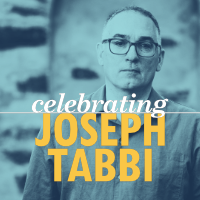
In his opening speech at Joseph Tabbi's festschrift, Scott Rettberg details Tabbi's journey through academia, his many achievements, and the projects he founded. Rettberg also reflects on his friendship with Tabbi, which started in Chicago in 1999 and, over the decades, has spanned the globe and numerous life events.
“Good afternoon, everyone. I’m Scott Rettberg, I’m the Director of the Center for Digital Narrative (CDN) and, in a past life, during the period I first met Joe, the co-founder of the Electronic Literature Organization (ELO). It’s my pleasure to welcome you to this celebration of the research career of Joseph Tabbi, Professor of English here at the University of Bergen.
Joe is someone who you might know in a variety of ways depending on the context in which you have encountered his work, and whether you have known him as a reader, or as a colleague, or as a mentor, or as a friend, or all of the above. Many of you here will know Joe only from his most recent work here at the University of Bergen and as a principal investigator at the Center for Digital Narrative. But Joe has also had a full and illustrious career as an author, theorist, and editor that stretches back to the 1990s, to the period of late postmodern American literature and the beginnings of the World Wide Web.
Joe has been here in Bergen for the past six years after teaching American Literature for many years at the University of Illinois at Chicago. And, before that, early in his career as an assistant professor in Manhattan—Manhattan, Kansas that is, after earning his Ph.D. in 1989 at the University of Toronto with his dissertation, “The Psychology of Machines: Technology and Personal Identity in the Work of Norman Mailer and Thomas Pynchon.” As an undergraduate, Joe graduated with both a BS in Engineering Physics and a BA in literature, and throughout his career he has continued to engage with the connections between literature and technology. To move further back in history, Joe grew up in a small town in upstate New York in a close-knit Italian- American family, a part of the world to which he will soon return, coming full circle with his upcoming move to Rochester.
Among other things, Joe is the biographer of the novelist William Gaddis, one of the most important modern/postmodern writers of the 20th century. His Nobody Grew but the Business: The Life of William Gaddis is the authoritative volume on that important American author, and he has already been the custodian and shepherd of Gaddis’s collected non-fiction and letters, with his service as the editor of Gaddis’s The Rush for Second Place: Essays and Occasional Writings. Tabbi also helped to shepherd Gaddis’s last fiction, Agapē Agape, a dramatic monologue by an elderly man with a terminal illness, to its publication with Penguin Classics.
You might know Joe as a scholar who has been consistently, critically engaged with the various intersections of science and literature, as evinced in his landmark 2002 monograph on cognition and self-reflexive autopoiesis, Cognitive Fictions. You might know him as an erudite cartographer of the connections between posthuman theory and contemporary literature in his most recent book, The Cambridge Introduction to Literary Posthumanism.
In another context, we all know Joe as the founder and editor of the electronic book review, an essential online journal of contemporary letters and culture, mapping, as Joe might say, “the process of literature’s becoming electronic,” which has now been in continuous publication for 30 years. ebr was one of the first serious journals to be invented online, and it has remained a central locus for cutting-edge critical discourse that would not at the time easily find a home elsewhere, and for methods that challenge the status quo, for in-depth work addressing the digital future of literature, theory, criticism, and the arts. ebr has served a crucial function as it has and continues to serve as a hub for new critical discourse networks as they emerge and develop. ebr’s work continues at its new home here at the University of Bergen’s Center for Digital Narrative, where our team is working with managing editor Anna Nacher and a newly reconstituted editorial board to assure that ebr has a bright future at the same time as we are working with our university librarians to see that we have a durable and searchable archive of its past, along with the special collection that you see displayed in the exhibit in this room.
You might also know Joe through his work with the Electronic Literature Organization, of which he served as President from 2007-2010, and where he continues to serve as one of its longest-serving board members. His work on electronic literature also extends to his work as editor of the extensive anthology, The Bloomsbury Handbook of Electronic Literature published in 2017.
Joe’s work at ELO was particularly important in the context of the Electronic Literature Directory, which he has led the revitalization of, and the establishment and work of the international Consortium on Electronic Literature, and of course this field-defining work has continued with his work as one of the founding PIs of the Center for Digital Narrative where, working with Hannah Ackermans, he has initiated the new Living Glossary of Digital Narrative project.
My own history with Joe begins around the time we started the ELO, in 1999. I had just moved to Chicago while on a Taft dissertation fellowship. My adviser at the University of Cincinnati, Tom LeClair, had told me that one of the things I must do while I was living in Chicago was to look up Joe Tabbi, as he was the scholar of note in all things digital, literary, and networked. I dropped Joe an email, and as it turned out, at the time Joe lived only a few blocks from the Westtown apartment I had just moved into. We met for a coffee at Leo’s Lunchroom on Division Street and I told him about the hypertext novel The Unknown that I had just written with some friends, and he told me about ebr and his thoughts on the networked future of literary studies. Subsequently, when along with Robert Coover and others I developed the idea of establishing a non-profit organization focused on electronic literature, Joe was one of the people with whom I talked through this notion and who supported it wholeheartedly, and helped me to strategize its initial development when many others in my life thought it to be an improbable, if not delusional, distraction from completing work on my dissertation. Soon, Joe and I were meeting regularly for a beer almost every Friday evening, whether an Old Style at Jean’s Place on Paulina or a Żywiec at Cut Rate Liquors (known to the locals as Cut Throat Liquors). Both of those beers, it should be noted, could be had for $1.50, and were thus suitable for an American graduate student’s de minimis salary. They were working class beers for working discussions of the future of literature. At this time too, a small group of us formed “the Chicago School of Electronic Literature” which, inspired by the Oulipo, met for a meal once a month at Mohti Mahal restaurant on Belmont on Chicago’s North Side, a few blocks from Rob Wittig’s apartment at the time, for sustenance and sprawling conversations, with a rotating cast of guest luminaries, all sharing our field notes on the emerging world of digital writing.
When we did get the ELO up and running, Joe’s loft on Division Street became a local center of activity for this emerging field, a place where we would meet regularly for soirées with e-lit authors, and novelists, and poets, and artists, and scholars passing through town, a place where we hosted readings and demos, a place where the network that was developing online could meet in person, and break bread, and discuss and debate the potential futures of literature and what we could all do about it, and extend those debates to the broader field of contemporary literature. Joe’s hospitality, openness, and generosity as a host is something that I learned from and have tried to emulate since. While many of the networks in our field are digital, I’ve always found that the most significant, and most lasting, networks I’ve participated in are based on are the in-person connections that emerge when artists and researchers meet together, and share a bottle of wine, brewing new ideas, and conversing late into the evening, while developing enduring friendships that result in durational international collaborations.
When, a few years after starting the ELO, I finally did complete and defend my PhD dissertation focused on the network novel, Joe served as a reader and adviser, as he did for a number of other scholars writing dissertations in this field who are now helping to shape it. My dissertation defense featured Joe as what in Norway you would call an “opponent,” chiming in with his questions and observations over a crackling old-fashioned speakerphone (well before Zoom) from Riga, Latvia, where he kept a second home, leaving me to defend my research to an inquisitive, curious, disembodied, networked cyborg who was always already a fellow traveler into the unknown. Joe’s leap into and decades-long engagement with post-Soviet Eastern Europe from the 1990s to the present is another story that we could take hours to tell. Joe was there to watch the walls fall and new forms of democracy emerge firsthand.
One thing to stay about Joe’s manner of writing, which I’ve had the opportunity to observe over the years, and that I admire: he is a writer of patience, but one with a continuous sense of engagement. He has always allowed his ideas to gestate and evolve as a “Slow Learner” in Thomas Pynchon’s sense, and he has allowed himself the gift of focus. I remember that he was working on Cognitive Fictions, his Division Street loft was almost entirely of bookshelves, except for a narrow aluminum bracket he had attached to his home office wall. “Why so few books?” I asked him. “Oh, there are shelves full of them in my office at UiC.” He replied, “But when I’m writing, I only want to see the books I’m writing about.”
Joe has always recognized that scholars and creative writers, that publishing, technology, and society, all exist within a critical ecology, and that our interactions within technological networks are based fundamentally on human networks, to which attention must be paid, and thought and care expended, to see that they persist, just as we must likewise take care to see that what we value in the literary thrives in digital environments. And Joe, without fail, always has compelling and provocative things to say about literature in the digital present. And prog rock, and politics, and the evolution of culture that he has observed in his lifetime.
Many of us gathered in the room today have known Joe for a quarter century or more. I was friends with Joe before I ever got married, or had kids, or was his direct colleague. Over time, we have met at conferences all over the world, from Paris, to Toronto, to Australia, and the conversations we began at Leo’s Lunchroom have continued across all those years. As my own career has developed, and as he has been a guest at our homes so many times for so many dinner parties with out-of-town guests over the years, Joe has become, in a way, a part of our family. My children have known Joe their whole lives, a recurring presence of kind words, quiet advice, and easy laughter.
Some of you, however, have known Joe only a couple of years. It is a testament to his continuous interest in making connections that several of our younger researchers at the CDN have become deeply involved with the projects that Joe initiated, and with him, as a mentor and friend.
Joe and I share a common interest in the constrained writing of the Oulipo, and like Nick, we also had the privilege of interacting on occasion with the late Oulipian novelist Harry Matthews. One afternoon, over the course of a long stroll with me in Paris, Harry waxed nostalgic as he told me about his friendship with Georges Perec and the relationship between memory and writing, and directed me to read, among other texts, Perec’s book Je me souviens, a work driven by the simple constraint that each short text in the volume, mostly only a sentence or two long, should begin with the phrase “I remember.” As we begin this event and launch our foray into remembering our interactions with Joseph Tabbi and the influence of his work on our own, I’d like to conclude by reading a small bit of Perec’s introduction to Je me souviens:
These “Je me souviens” are not exactly memories, and especially not personal memories, but little pieces of everyday life, things that, in a given year or other, all people of the same age saw, experienced, shared, and which then disappeared, were forgotten: they were not worth remembering, they did not deserve to be part of history, nor to appear in the memoirs of statesmen, mountaineers, and sacred monsters. Yet sometimes they come back, a few years later, intact and tiny, by chance or because we were looking for them one evening, among friends… rediscovered for a moment, arousing for a few seconds an impalpable little nostalgia.
And now, it is my great pleasure to introduce our keynote speaker, Steve Tomasula. One of the United States most innovative experimental novelists, Steve Tomasula is the author of the novels Ascension; The Book of Portraiture; VAS: An Opera in Flatland, an acclaimed novel of the biotech revolution; TOC: A New-Media Novel and IN&OZ (University of Chicago Press). His short fiction has been published widely and is collected in Once Human: Stories. He is also the editor of Conceptualisms: The Anthology of Prose, Poetry, Visual, Found, E- & Hybrid Writing as Contemporary Art. Steve is a Professor Emeritus of English at Notre Dame University. In a few weeks, at the University of Chicago’s conference center in Paris, Steve himself will be honored with a scholarly conference titled “Steve Tomasula: The Art of Representation.”⏴Marginnote gloss1⏴Steve Tomasula’s keynote, “I Always Wanted to Be a Media Theorist Who Wrote with a Telegraph Key”, will be appearing in ebr soon! Expect an announcement in your inbox when it’s published!— Tegan Pyke (January 2026) ↩
Cite this essay
Rettberg, Scott. "What I Know about Joe: Introduction to a Celebration of Joseph Tabbi" electronic book review, 18 January 2026, https://doi.org/10.64773/3b2a-c26b