Who’s Afraid of Electronic Literature? – in recognition of Joseph Tabbi
In this essay, David Ciccoricco reflects on his early challenges in the then-emerging field of electronic literature and the pivotal role Joseph Tabbi played in Ciccoricco’s studies. In doing so, Ciccoricco sees the similarities between his and Tabbi’s thinking. Namely, that literary narratives create a reciprocal loop between media and cognition.
Who’s afraid of the big bad Web? Or, more specifically, who’s afraid of electronic literature? These questions were circling in my delicate postgraduate head over 25 years ago as I was desperately trying to find – and keep – enough supervisors to see through my PhD dissertation on interactive digital narratives (also known then as “hypertext fiction”). After ditching a career as a journalist, and with a desire to see more of the world, I had moved to the South Island of New Zealand to do a postgraduate degree on James Joyce. I knew that Ulysses, which I read as an undergraduate, had been described as the pinnacle of human literary achievement, and I wanted to get a better sense of what all the fuss was about. At the very least I thought it would be a decent cognitive workout.
After my arrival, one of my supervisors convinced me that it would be difficult to say “anything new” on Joyce (wrongly, I came to realize in retrospect, as virtuoso scholars such as Donald Theall [1997] and Darren Tofts [1998] produced dazzling works on Joyce’s hypertextuality and mnemotechnics). Anyway, I returned the next week with something “new” – a proposal on this thing called hypertext, and more specifically the ways in which hypertext fiction challenges conventional theories of narrative, reshapes traditional storytelling practice, and potentially tests the narrative imagination itself. That pretty much scared him away. He said he was not able to supervise a dissertation on hypertext. I was left to search for another supervisor (my eternal thanks to John Newton at the University of Canterbury who was there from the start and stuck with the project to the end). We found two other NZ scholars who came on as advisors, but that lasted only three or four months before their circumstances (their fear?) – forced another cut cord. I needed to look further afield. But I had an idea.
Joseph Tabbi is not afraid of electronic literature. Along with Mark Amerika, Joe (as I call him) started an online journal called the electronic book review (ebr) in 1995 that published “critically savvy, in-depth work addressing the digital future of literature, theory, criticism, and the arts.”1 I knew that because my first ever academic publication, a review essay of Michael Joyce’s Twilight, a Symphony (2002), found a happy and welcoming home there. When I emailed and asked him if he would consider an advisory role for my dissertation, he said sure, and he asked if I would consider helping as a managing editor for ebr. I said absolutely. (I’ll be perfect, I thought… I’m a failed journalist!) It was an intellectually exhilarating mix of old school editing and new age markup. Lori Emerson joined the team and brought with her a rich knowledge of poetry across media that complemented my narrative-mindedness (see Figure 1). We were electropoetic DreamweaversTM setting the cyberstage for a new generation of digerati. (Despite the serious-looking expressions in the photo, I promise we didn’t seriously talk like that…)
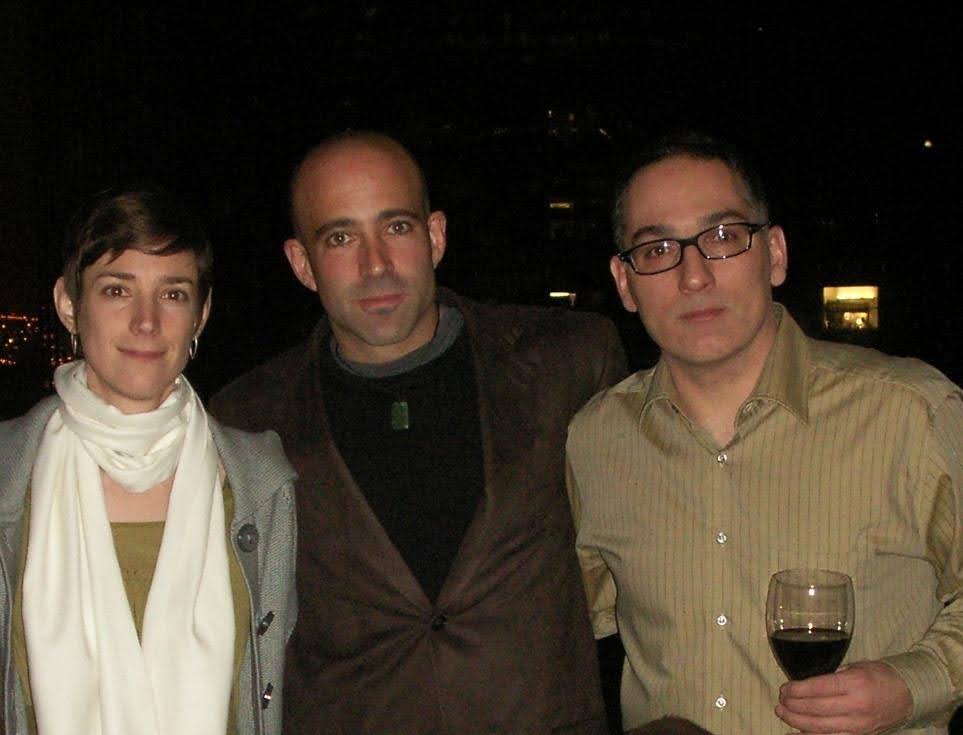
Figure 1. An ebr “editorial” collection: Lori Emerson, David Ciccoricco, and Joseph Tabbi, circa 2007.
As I look back now, some quarter-century realizations come more sharply into focus. Both of us have always been deeply invested in applying narrative-theoretical approaches to digital literary works – first, to show that this was even possible, and next, to show how we might need to expand or reinvent some of those approaches in turn. I realize that our commitment to electronic literature, however, was always and still is rooted in the idea that any interrogation of media is also an interrogation of mind. Joe’s landmark Cognitive Fictions (2002) hit the scene in my first years of working under his guidance. It was a transgressive and groundbreaking work that helped cultivate the path to what would come to be called “cognitive literary studies.” That book traces narrative “figurations of mind” within a “new medial ecology” (2002, xi). Much like Virgina Woolf (1925) famously sought to “record the atoms as they fall upon the mind in the order in which they fall,” Joe’s study continued the project of tracing “how the moment-by-moment operations of human thought find narrative form.”2 (He is not afraid of Virginia Woolf either.)
From the obsessively recursive and totalizing notation of Harry Mathews’ journalist to Joe’s own hypertextual traversal of Stephanie Strickland’s True North, we both share the belief that we have much to learn about actual minds from fictional ones. And we both see literary expression, in any medium, as a way to keep our minds alive to our media environment. I said something like that in my contribution to Joe’s award-winning edited collection, The Bloomsbury Handbook of Electronic Literature (2017, 150).3 In an email exchange about the collection, Joe singled out the passage in praise. I was flattered yet unsurprised, because I saw that idea as part of what I always regarded as our shared cause. That also entails – to use his terms – reading beyond the surfaces that screen us in and indulging a “palpable desire to go deeper, to stay in touch (literally; affectively) with the media that constrain our reading and writing” (2017, 3).
I realize that we both pursue the notion that literary narratives, whether in print or on screen, help structure a careful reciprocity in how media shape cognition and cognition shapes media in turn. That is, a healthy literary ecology ensures that we are alive and alert to sociotechnical change – that we use our media at least as much as it uses us. Humans are not all bad. But we are a destructive and inescapably egocentric species – in the sense that consciousness delimits an experientially insular and personal universe for each of us. And we most certainly need to take (more) action to put things right. Literature can enlighten that action. Through an array of strategic couplings, with anything from systems theory and critical posthumanism to ecocriticism and Buddhist-inflected enactivism, our own reading and theorizing can help us get out of our own heads and into those of others by bootstrapping the same neural apparatus that ensnares us. Of course, for all that we need a decent dose of fearlessness and intellectual generosity. It’s an honor to write a tribute for a scholar who possesses and shares both qualities in equal measure.”
Works cited
Ciccoricco, David. “Returning in Twilight,” electronic book review, 21 January 2002, https://electronicbookreview.com/publications/return-to-twilight/.
______ “Rebooting Cognition in Electronic Literature,” in The Bloomsbury Handbook of Electronic Literature, Joseph Tabbi, editor. University of Minnesota Press. 2017.
Tabbi, Joseph. Cognitive Fictions. University of Minnesota Press. 2002.
______ The Bloomsbury Handbook of Electronic Literature, University of Minnesota Press. 2017.
Theall, Donald. James Joyce’s Techno-Poetics. University of Toronto Press. 1997.
Tofts, Darren. Memory Trade: A Prehistory of Cyberculture, Illustrated by Murray McKeich, Interface. 1998.
Woolf, Virginia. “Modern Fiction,” in The Common Reader. Hogarth Press. 1925.
Footnotes
-
This is ebr’s current site description. ↩
-
The phrase features in the book’s promotional material. ↩
-
The Handbook is one of a number of publications on our shared scholarly highlight reel; other major collaborative projects would include his edited collection, Post-Digital: Dialogues and Debates from electronic book review (Bloomsbury 2020) and my special issue, “What [in the World] was Postmodernism?” (electronic book review, 4 December 2016). ↩
Cite this essay
Ciccoricco, David. "Who’s Afraid of Electronic Literature? – in recognition of Joseph Tabbi" electronic book review, 18 January 2026, https://doi.org/10.64773/b4cf-2df4