2018
Berry, who with ebr editor Joseph Tabbi initiated the Fictions Present thread (circa 2006), finds few intersections of that project with Hungerford’s celebrated Making Literature Now, not least because Hungerford shows little interest in the question of how her titular concept, when applied to commercial and cultural productions, indie and alt endeavors, “manages to mean what those trying to make literature are trying to make.”
What binds literature, electronic literature and games is "the shaping and networking of the imagination." Drawing on the ideas of Damasio, Walton and Sartre, Gordon Calleja looks at the synthesizing role of the imagination in narrative indie games.
Beginning as a talk delivered at the National University of Kyiv-Mohyla Academy, Ukraine May 17, 2017, now edited and amplified for publication in the electronic book review and the 2018 collection of ebr essays forthcoming from Bloomsbury Press.
Repetition, gestural abstraction and depictions of noise; anabsence of narrative causation, a multiplicity of micro-narratives and opacity of material communications: The digital narrativity observed and created by Will Luers is equally applicable to the films of Stanley Kubrick or the paintings of Hieronymous Bosch - which implies a longer continuity (and less radical transformation?) than we might have expected. Indeed, Luers argues that "networks and nonlinear systems" might better be understood as "something deep in our brains," even as narrative may be regarded "as a necessary construct, but not the complete picture of reality."
Gregor Baszak parses Nagle's celebrated, and "overdue" reconsideration of the internet, and social media in particular as a battlefield for politics.
If it's true, as Leiya Lee argues, that Akira Mizuta Lippit turns Derridean theory into a system, then it's a system grounded in ghostly presences (not least Derrida's own presence in film).

2017
ebr Associate Editor Lai-Tze FAN responds to Dani Spinosa's review of *llegal Literature: Toward a Disruptive Creativity,*by David S. Roh.

David Jhave Johnston responds to Theadora Walsh's review of his book Aesthetic Animism: Digital Poetry's Ontological Implications.
Dani Spinosa reviews David S. Roh's Illegal Literature a book about authorship, copyright, fair use and literary disruptions.
"More is not necessarily more. Faster is not necessarily better. Big data is not necessarily better." In the effort to capture and make available data about people, digital humanities scholars must now weigh the decisions of what and what not to share. Geoffrey Rockwell and Bettina Berendt address the new ethical issues around “datafication” in an age of surveillance.

A review of Aesthetic**Animism, so vulnerably personal, and at the same time so pragmatically organized, that it might just suggest a possible future for scholarly and creative scholarship: a digital practice that (in Jhave's words) "distends selves towards collectivities that remind it of oblivion." For the moment, that inevitability is avoided by the book's receipt of the 2017 N. Katherine Hayles Award for Criticism of Electronic Literature.

"Even among the Greeks and Romans, the most advanced nations of antiquity, money reaches its full development, which is presupposed in modern bourgeois society, only in the period of disintegration."- Karl Marx, Introduction to A Contribution to the Critique of Political Economy
Though scholars of literature and the arts remain skeptical, Strunk explores some of the ways "videogames are making the transition into being objects worthy of artistic attention."

Reflecting on the genealogy and histories of "transgressive textualities" and text generators, Aquilina offers readings of texts by Swift, Dahl, Orwell, and Borges to consider the terms and issues involved in situating text generators as transgressive.
In this review of O'Nan's West of Sunset, Messenger explores 20th Century American literary history as a kind of contemporary metafictional myth. Using Scott and Zelda Fitzgerald as characters composing the life of a literary icon against the emergence of "Hollywood," O'Nan's work is considered a bittersweet meditation on the death of an author and the hope that his work lives on.

In her discussion of the textual, technical, and figurative characteristics of Graham Allen’s Holes (2017), Karhio “argues that [Allen's text] is not a landscape poem in the customary sense” and explores the ways in which the digital platforms deployed in the project’s creation and publication contribute to the signifying structures that “challenge the idea of landscape as symbolic representation of the inner world of the speaking subject.”

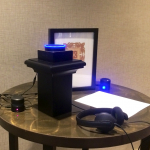
Reading practices have changed along the course of history. Before the ‘democratization’ of the written word - from Homer's Iliad to the medieval troubadours and to more recent public and private oral reading traditions -, reading has long been associated with listening. Today, in the age of algorithms and ‘smart’ interfaces, the sharing of language between humans and computational devices is increasingly ubiquitous and, with the standarization of artificial intelligence systems like Siri, Cortana, and Google Now, we are starting to speak and to listen to machines. In the field of digital literary creation, one example of aesthetic reflection on the questions raised by such networked ‘smart’ interfaces is John Cayley's The Listeners (2015), "a linguistic performance — transacted by visitors and Amazon’s voice-activated Artificial Intelligence and domestic robot, Alexa" (Cayley, 2015b). Through an analysis of The Listeners, articulated with Bernard Stiegler’s notion of the digital pharmakon, this paper aims to reflect on the encounter between literature and digital technologies. Three ideas will be highlighted: 1) the ways in which the technical, economic and political layers that constitute our digital devices pre-determine their usage (how they operate and are operated); 2) the automatic processing of language and orality as interfaces of mediation between humans and “smart” devices; 3) the literary implications of aurality and aurature.
In this review of Henry Turner’s The Corporate Commonwealth, Thomas considers how Turner historicizes the term “corporatization” to explore its wide-ranging definitions and functions in early-modern England.
The Corporate Commonwealth: Pluralism and Political Fictions in England, 1516-1651 Henry Turner, Chicago UP, 2016

In this review of The Power at the End of the Economy, Lestón delineates the theoretical apparatus of Massumi's book and its possible implications.
In this review of Mark Seltzer’s The Official World, Ulmer reflects on the interdependence of “the official” and “the unofficial” in contemporary constructs of reality.