2008
Emily Short explains that one of the goals of Savoir-Faire is to teach the player to become a magician. This pedagogical orientation means that - in contrast to interactive fictions that allow only a severely limited range of player input - Short's game rewards undirected play because the player is not only solving puzzles, but also learning.
Lev Manovich describes a filmic methodology for the information age: narratives structured on the logic of databases. The delegation of a large part of the editing Mission to Earth to a computer results in a product that is "between narrative and a search engine."

Talan Memmott describes The Brotherhood of Bent Billiard as "a narrative hack of Magritte's symbolic calculus"; it allows the reader to negotiate a number of clickable Magritte-inspired screens, which provide the reader a forum for thinking through the questions of representation immanent in the painter's work.
Steve Meretzky reflects on one of the earliest (1982) NPCs (non-player characters) to evoke an emotional investment from videogame players. Meretzky draws attention to the fact that character development - integral to fiction and film - is not often emphasized in game design.
Helen Thorington describes Solitaire, a program for generating fiction in the same line as the projects explained by Chris Crawford and D. Fox Harrell elsewhere in this thread.

Stuart Moulthrop argues that Pax answers John Cayley's question, "What would textual instruments look like?" Moulthrop maintains that one plays this electronic text (in the manner of a musical instrument) as much as one reads it.

Nick Montfort argues that the contentious notion of the "player character" usefully constrains and makes possible the player's interaction with the gameworld. He considers the possibility that in interactive fiction one plays the character (like an actor plays a role) rather than playing the game.

Jeremy Douglass evaluates Shade within the history of interactive fiction, and considers how light is represented in the code structure of scene descriptions, arguing that "[w]ithout vision there is no agency."

Carl McKinney argues that Jeremy Douglass's analysis of Shade suggests a presence/absence dynamic useful for understanding interactive fiction in general.
Mark Keavney describes his process in composing a story in which the readers voted on plot points as he was writing, resulting in a truly interactive fiction - a narrative in which, as Keavney puts it, "[n]either the players nor I owned the story completely."

Jeff Tidball contends that the Second Person collection makes too much of the narrative vs. play debate, and pays attention to the mechanics of narrative and play over their affective capabilities.
Jan Van Looy criticizes Erik Mona's history of Dungeons & Dragons as overly descriptive, and Van Looy critiques the game's quantification of the qualitative, i.e., personal characteristics and magic - which were hitherto considered unquantifiable.
Jordan Mechner explains how the team developing of Prince of Persia: The Sands of Time incorporated a number of cinematic techniques such as flashback and voice over (which do not usually figure into video games) while also working within the practical restrictions of a commercial production schedule.

Michael Mateas and Andrew Stern argue that new media practitioners and scholars should be literate in the code that underlies their objects of creation and study. To this end, they explain how they structured the code of their computer-based interactive drama Façade, which capitalizes on the procedural nature of computers to create a forum for participatory drama that negotiates players' local and global agency within the game world.

Robert Zubek describes how his program takes advantage of the tropes of breakup conversations. These generic norms allow The Breakup Conversation to assess players' textual entries categorically rather than semantically and thereby convincingly simulates an IM-based interaction.

Chris Crawford walks through Deikto, an interactive storytelling language that "reduce[s] artistic fundamentals to even smaller fundamentals, those of the computer: addition, subtraction, multiplication, and division."

D. Fox Harrell considers what is computational about composition, and describes the GRIOT system for generating literary texts.
Lee Sheldon describes his playable adaptation of Agatha Christie's And Then There Were None, which relies on his invention of a "suspicion meter" to quantify and track the player's interaction with - and assessments of - NPCs (non-player characters).

The electronic release of Second Person starts with a number of essays on tabletop role-playing. Most of these consider the entanglement of play and narrative in a variety of game systems, from the highly controlled to the largely open-ended.
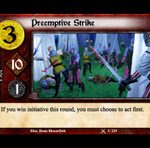
Eric Lang (with Pat Harrigan) explains the advantages writers have in crafting adaptations of literary franchises into collectible card games. Lang maintains that, while attempting to remain true to the original, when turning narratives into games, one must "respect the medium."