John Cayley on Joe Tabbi
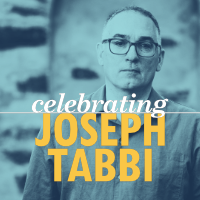
Continuing the celebration of Joseph Tabbi's work, John Cayley discusses Tabbi's foresight and ability to gather his peers together, which led to the creation of vital knowledge infrastructure for the blossoming field of electronic literature.
It is a great pleasure and an honor to be able to offer a brief tribute to Joe for this special issue of ebr, along with heartfelt congratulations on Joe’s retirement. It is difficult to exaggerate what Joe Tabbi has done for literature as a field, and for electronic literature in particular. Joe has read fiction as cognitive and extended a critical reading of this kind into a world within which tools for writing were and are being read as themselves cognitive. It isn’t just the ideas Joe published. Joe helped to build a knowledge infrastructure for this field: electronic book review, the ELO, the digital review, and many other initiatives.
In this context, I want to thank Joe more personally for the friendship and for the support that he has given me and my work way back to the earliest emergence of literary art with computation. Joe pushed me hard to finish and publish a hypertext essay for ebr in 1997! At this early date, Joe knew that hypertexts could and should be first class discursive objects, that they could and should be academically, institutionally credited, even when they were composed by so-called independent scholars, who are still too often taken for second class academic citizens.
It’s worth saying that Joe Tabbi knew what he was doing way ahead of its time. The field needed a venue that was peer reviewed, and he created that potential, simply, and quite rightly, by being and gathering peers, rather than looking so-called ‘up’ to specious existing authorities. Not only did Joe push my weird hypertext—its avant garde skeptical title quoting William Gibson, ‘Why Did People Make Things Like This’—but he also shepherded my most cited critical paper into ebr: ‘The Code is not the Text (Unless it is the Text)’, giving me one of my few actual experiences of: trying to say something, discovering that many other people thought you were saying something else, not being entirely sure whether they were wrong about this, and then becoming happily certain over time that not only could you have expressed yourself better, you have in the process, learned so much more about what you thought you wanted to say then, and what you’d rather say now. And, now, all I want to say is thank you, Joe, and congratulations once again, and always.”
Cite this essay
Cayley, John. "John Cayley on Joe Tabbi" electronic book review, 18 January 2026, https://doi.org/10.64773/8346-5b0e