2019
Between the manifesto and the treatise, the text and the paratext, the theoretical and the poetic, the aphoristic and the systematic: Manuel Portela situates the "expressive richness" of Johanna Drucker's "General Theory," and its critique of present social and political formations.
A consideration of Monstrous Weather, a recent netprov (or networked improvisation) and the ways that collaborative storytelling encourages the rereading, retelling, rewriting, and adaptation of stories that begin as performances, and then turn into a form of archiving through still further rereading, rewriting and retelling. Author Alex Mitchell begins by depicting how, during the original performance of Monstrous Weather, there was a constant reworking, remixing and retelling of texts, both literally and through references and embellishments. This process gradually coalesced the loose collection of story fragments into something that had a kind of coherence, if not as a story, then at least as a storyworld. Mitchell discuss two particular performances/remixes: a live reading of excerpts from the netprov performed at the Electronic Literature Organization (ELO) Conference 2017 almost exactly 1 year after the initial performance, and a subsequent hypertext remix/archive.
An Mosaic for Convergence, Charles Bernstein's hypertext essay from ebr Issue 6 in the Winter of 1997-1998, explores the ramifications of a literature that is not structurally challenged, but structurally challenging. By then, Bernstein could sense a shift in literary sensibility, where it was beginning "to seem as natural to think of composing screen by screen rather than page by page." That was a few years after the flourishing of hypertext, but before the internet made reproduction of our print corpus a dominant practice (as e-books, primarily, with very little print/screen interplay or reader/author/programmer interchange). The moment Bernstein describes, and its instantiation on ebr's Alt-X legacy site, seems to the ebr editors something worth preserving - if only as a measure of recognized literary possibilities that have not been realized.
Bernstein's essay is the first of many that will be recovered by ebr co-editor Will Luers, and re-produced in the journal's version 7.0 (circa 2018-2019).
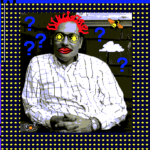
Rettberg's and Jackson's interview, and their creative work's direct engagement with environments anticipate the themes in a forthcoming ebr gathering by Eric Rasmussen and Lisa Swanstrom, titled Natural Media. More than just an articulation of environmental 'issues,' the creative work of Jackson and Rettberg actively integrates snowfall in Brooklyn, tattooed skin on bodies, pollutants in Jersey City and New Orleans (post-2012), and other particles and particulars that are touched by natural and medial ecologies.
This conversation is published as the fourth in a series of texts centered around the publication of The Metainterface by Søren Pold and Christian Ulrik Andersen. Other essays in the series include: The Metainterface of the Clouds, Always Inside, Always Enfolded into The Metainterface: A Roundtable Discussion. and Voices from Troubled Shores: Toxi•City: a Climate Change Narrative.

Babak Elahi shows how electronic literature in its public display, its interactivity, and its paradoxical combination of ephemerality and permanence brings us closer to the ancients than to the moderns - and closer still to the collective ritual experiences that Arabic and Muslim literature always valued over Western individualism. Further still, the emergence of Arabic e-lit does not just mean inclusions of still more cultural or ethnic identities. The politics of identity is yet another Western concern that an online Arabic poetics is happy to leave behind.
2018
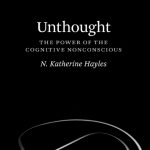
Cognition, as we've known for quite some time, is much larger than consciousness. And that realization can help explain literature's longtime, productive fascination with the unconscious. But today, when a scholar such as N. Katherine Hayles connects "nonconscious cognition to a wide range of technical, financial, and literary issues," we are set to fundamentally rethink the "nature and value of the humanities today."
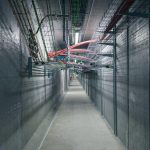
At the moment when post-fictional fictions, essayistic fictions, and design fictions emerge as a cultural dominant, Rettberg, Swanstrom, Nesheim, Anderson and Pold discuss an emerging "aesthetics of infrastructure." Quietly condoned, mostly unnoticed installations of "Camouflaged Cell Concealment Sites" are now being visited by artists such as Betty Beaumont and Trevor Paglen. When our cloudy digital industries are so busily constructing cell phone towers that look like pine trees or Saguaro cactuses (sort of), the role of literary and visual artists may be simply to document these found fictions - for as long as they don't get arrested.
This conversation is published as the second in a series of texts centered around the publication of The Metainterface by Søren Pold and Christian Ulrik Andersen. Other essays in the series include: The Metainterface of the Clouds, Voices from Troubled Shores: Toxi•City: a Climate Change Narrative and Room for So Much World: A Conversation with Shelley Jackson.
This gathering by Dani Spinosa provides ebr readers with a glimpse into the discussions and debates at the 2018 Arabic E-lit Conference in Dubai.

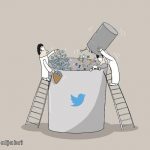
In this essay, Doris Hambuch uses the image-based work of Arabic cartoonist Khaled Al Jabri to address concerns of technological dependence to reconsider our use of screens. Rather than simply reprimanding readers about the potentially negative dependence of our contemporary society on technology and its screens, Hambuch instead proposes that we look to Al Jabri's work as a way of reconsidering the role of the screen in visual poetics and graphic literature.
Dani Spinosa, who edited and introduced the Dubai gathering, endorses Hayles' position on the collaborative, cognitive, and (not least) communal potential of human-computer co-authorship.
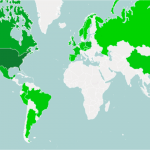
In her essay, Egyptian elit scholar Reham Hosny observes and quantifies the ways that Arabic electronic literature has been historically underrepresented in the predominant critical venues like the ELO's Electronic Literature Collections and other central repositories for the dissemination and study of e-lit. Rather than simply observing this vacancy, however, Hosny proposes real, practical methods for addressing and bridging this discrepancy, bringing new works to light and encouraging translation, open access, and consideration of the language-based and nationalist biases in the scholarship surrounding elit.
In this essay, John Barber argues that sound suggests a new and valuable way of approaching and considering Arabic electronic literature. Based on the oral histories of Arab cultures, the use of sound in Arabic electronic literature provides a way of knowing and being in a literary world, real or imagined. Sound makes readers re-think their relational experiences with others, with themselves, and the spaces and places they inhabit. These shifting relationships promote interesting opportunities for Arabic electronic literature.

In this essay, Serge Bouchardon looks to electronic literary and its important predecessors in a way that prioritizes gesture and manipulation. Bouchardon interrogates how technology alters and opens the way that literature can be materially engaged-with by its readers, a way that deliberately encourages its readers to engage physically and agentially with the text. In this way, Bouchardon reveals a way of critiquing electronic literature that expands upon the physically-engaging properties of print.

O'Sullivan's essay appears at about the same time as a post to the Electronic Literature Organization list, revealing details of the Summer 2019 ELO Conference & Media Arts Festival, to be hosted by O'Sullivan at University College Cork, Ireland: http://elo2019.ucc.ie/

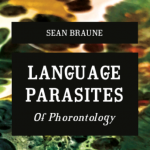
For a journal like ebr, long devoted to peer-to-peer reviews (of writers for and by writers), the engagement by Jhave with Sean Braune's Language Parasites suggests a variation on that model. Their parasite-to-parasite encounter bodes well to supplement (if not overtake) the hidden, professionalized peer review models that keeps all of us so busy and so hidden from view - of one another, not to mention our potential audiences. What better outcome for born digital scholarship than the replacement of "double blind" peer review with a "phorontology" of ties that bind, "[extending] its embrace to all"?Sean Braune's publisher has offered ebr readers a free pdf of Language Parasites. Print versions can be ordered from Punctum Books
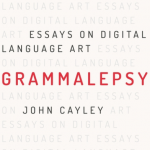
From an author celebrated for a career devoted to the digital, Cayley's book offers a cogent demonstration that "verbal language has been ideologically fettered to the medium of print for far too long." Ensslin, in her riposte, notes how Cayley's venture into a pre-digital format resonates with numerous recent works (in print and online; creative and critical), offering a "much-needed pathway out of institutionalized literary systems and practices.
This discussion is adapted from a presentation by Roderick Coover and Scott Rettberg of Toxi•City and other CRchange projects at the Arts Santa Mònica museum in Barcelona on March 3, 2016.Toxi•City was exhibited there as part of the “Paraules Pixelades” exhibition.
This conversation is published as the third in a series of texts centered around the publication of The Metainterface by Søren Pold and Christian Ulrik Andersen. Other essays in the series include: The Metainterface of the Clouds, Always Inside, Always Enfolded into The Metainterface: A Roundtable Discussion. and Room for So Much World: A Conversation with Shelley Jackson.

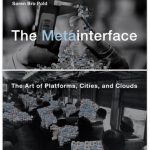
The following assemblage, one of a series initiated with ebr version 7.0, is composed of four elements: a presentation (for release in October 2018) of Søren Bro Pold & Christian Ulrik Andersen’s The Metainterface including an excerpt from “The Cloud Interface: Experiences of a Metainterface World” chapter of the book (with permission from The MIT Press); a discussion (November 2018) by Scott Rettberg and Roderick Coover about the visual and narrative design of Toxi•City: a Climate Change Narrative, and a discussion of issues raised by The Metainterface (December 2018) that were taken up by the Bergen Electronic Literature Research Group during the EcoDH seminar, University of Bergen, June 14, 2018, and an interview with Shelley Jackson (January 2019) focused on her project Snow and her new novel, Riddance; or, The Sybil Joines Vocational School for Ghost Speakers & Hearing-Mouth Children. Contributors: Christian Ulrik Andersen, Roderick Coover, Shelley Jackson, Elisabeth Nesheim, Scott Rettberg, and Lisa Swanstrom.
This essay is published as the first in a series of texts centered around the publication of The Metainterface by Søren Pold and Christian Ulrik Andersen. Other essays in the series include: Always Inside, Always Enfolded into The Metainterface: A Roundtable Discussion., Voices from Troubled Shores: Toxi•City: a Climate Change Narrative and Room for So Much World: A Conversation with Shelley Jackson.
Aquilna reflects on the reflections in Callus and da Silva's "Strange Metapaper."