2004
The "cognitive entailments" of a reader, or "interactor," are where Katherine Hayles redirects the new aesthetics of electronic textuality.
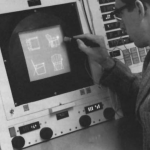
Simon Penny recalls that the origins of the human-computer interface, politicized by a military heritage, are now explored by artist-enigineers who chaperone fragmentation and dissent.
Tim Keane reviews Genet's republished Prisoner of Love, a 'mirror-memoir' in which Genet sees Palestine from the inside in an attempt to see himself from the outside.
2003
Reiichi Miura considers the worldwide reception of Japanese writer Haruki Murakami and charts a course for a fiction where nationalism loses relevance.

Richard Schechner remembers the real-life side of interaction.
Juggling economies and unknotting threads, Victor Vitanza pulls back to drop the curtain, theoretically, on The Politics of Information.
Marc LaFountain reviews a new collection of Bataille's writings and considers the philosopher's thoughts on prayer in a system and practice of atheology.
The Politics of Information: fifth and final installment under the Technocapitalist thread.
Chris Carter and Greg Ulmer dialogue through e-mails on the mission of the FRE.
Katie King on the challenges and rewards, in her own life and the lives of her students, that emerge when writing about personal encounters with technology.
Whether they fret over Ziggy Stardust or the condition of posthumanity, fans and scholars share, argues Harvey Molloy, a few habits of mind.
A survey of humanities research websites (and how to teach with them) by Susan Schreibman.
Laura Sullivan and her students explore webwriting and content provision as activist tools.
Pattern, absence, routine, return - Dave Ciccoricco mulls the shape(s) in Michael Joyce's new paper novel, Liam's Going
In The Politics of Information, v.4, Bousquet, Wills, and Co bring their critique home to Higher Education.
Tim Luke takes on the business of online learning.
Marc Bousquet discusses university labor delivered in "the mode of information."
Stephanie Tripp addresses Spectres of Marx, the text featuring some of Derrida?s most detailed encounters with both historical materialism and information technology.
Junk bond swami Michael Milken jumped out of prison a few years ago and into for-profit education. Ken Saltman submits Milken's latest venture to the light of day.